
A complete, concise Archive account. Free to read in full.
San Juan County, Utah, United States · Discovered 18 November 2020
The helicopter crew had gone out to count bighorn sheep.
Below them lay the red sandstone country of south-eastern Utah: ledges, gullies and narrow passages between rock walls. During the survey, someone on board noticed a shape which did not belong to that landscape.
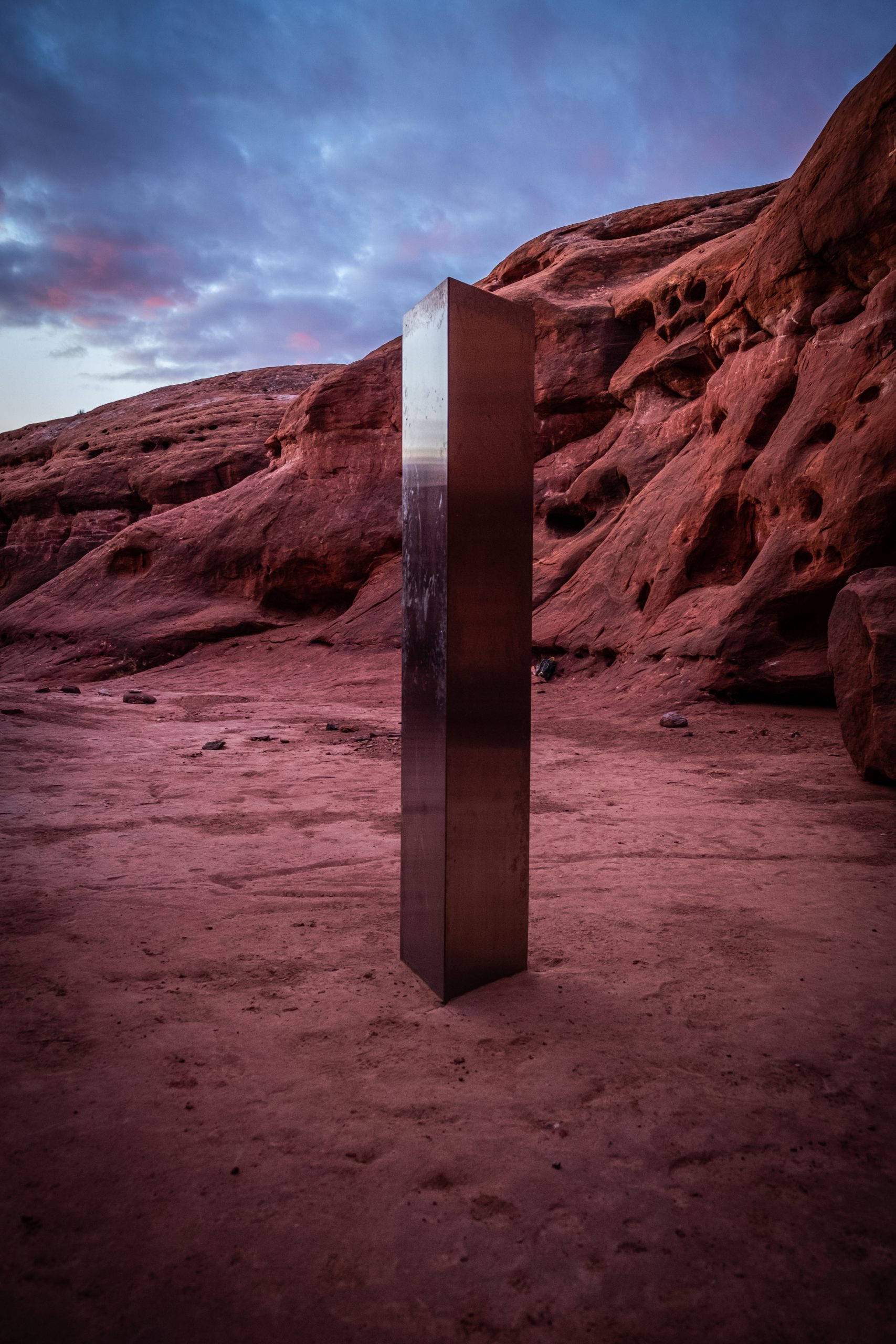
The crew landed. In a small canyon stood a reflective metal pillar, nearly three metres tall. Its sides rose straight from the sandstone. There was no plaque to read, no signature to recognise.
Someone had brought it there. Someone had chosen that particular patch of rock.
Nine days after the discovery, the pillar was gone.
The Object in the Canyon
The discovery team included personnel from the Utah Division of Wildlife Resources and the Department of Public Safety Aero Bureau. Their encounter on 18 November 2020 became international news after officials released photographs and video.
The precise location was initially withheld. The authorities were concerned that people searching for the object in remote country might become stranded and require rescue.
The photographs offered a more immediate invitation. A severe, upright form stood against weathered rock, reflecting the light around it. For viewers familiar with Stanley Kubrick’s 2001: A Space Odyssey, the comparison was almost unavoidable.
Closer inspection revealed a recognisable method of construction. This was a hollow, three-sided metal structure with riveted seams, installed in a cut in the sandstone. Its strangeness lay in the setting and the absence of an explanation, rather than in any unfamiliar material or technique.
The Years Before Discovery
The first photographs suggested an arrival. Historical satellite imagery suggested something else: the pillar had already been there for years.
Comparisons reported after the discovery placed it in the canyon by October 2016. Some analyses narrowed the installation window to between July and October that year; earlier reporting used a broader interval beginning in 2015.
The essential point was the same. This was not an object newly placed in the desert during November 2020. It had stood there for roughly four years before the helicopter crew brought it to widespread attention.
That interval leaves room for several stories. An artist might have wanted a work to be encountered by chance. A private joke might have been intended for very few people. Someone might simply have enjoyed making an object whose explanation remained their own.
None of those intentions can be recovered from the satellite images. Nor can the images tell us whether earlier visitors had already found it and said nothing publicly.
The Evidential Divide
What survives: photographs of the structure and its construction, historical imagery, the discovery team’s account, official statements and testimony about its removal.
What remains unverified: the identity of the original maker or makers, their purpose, and whether the eventual public reaction was anything like the one they intended.
The Internet Finds the Site
The withheld location did not remain secret for long.
Online investigators compared the released footage with maps and satellite imagery. The shapes of the cliffs, the canyon floor and the surrounding terrain offered clues. Within days, visitors were reaching the site and publishing their own photographs.
The object now had an audience far larger than its narrow setting could comfortably accommodate.
On 29 November, the Bureau of Land Management reported vehicles parked on vegetation and human waste left at the undeveloped site. The pillar had been installed on public land without authorisation. What had appeared in photographs as an isolated encounter had become a problem of access, damage and responsibility. [1]
The new photographs also brought the object closer. Rivets and joins became visible. Visitors could walk around its triangular form, touch its surfaces and examine the base. The more clearly its construction emerged, the more the unanswered question shifted towards authorship.
An Artist Without a Name
One name appeared repeatedly: John McCracken.
The American artist was known for minimalist sculptures whose polished surfaces and simple geometry could seem both industrial and strangely unfamiliar. The Utah pillar invited comparison with his work.
McCracken had died in 2011, before the installation period suggested by the satellite record. That did not make a later installation of an existing work impossible, but it left a substantial gap between resemblance and attribution.
People associated with the artist offered differing views. No documented chain of ownership or installation established the pillar as his. A homage was another possibility, but that too remained an interpretation.
Other artists and makers were proposed. Public claims and speculation generated further attention without producing a verified account of the Utah installation. The appearance of similar structures elsewhere made it easier to confuse the maker of a later monolith with the maker of this one.
An anonymous artwork remains a persuasive reading. It is still a reading, rather than a recovered explanation.
The Night It Was Removed
On the evening of 27 November, photographer Ross Bernards was at the site when four men arrived.
His account described a brief, practical operation. The pillar was pushed over, dismantled and carried away with the help of a wheelbarrow. What had looked immovable in photographs proved portable.
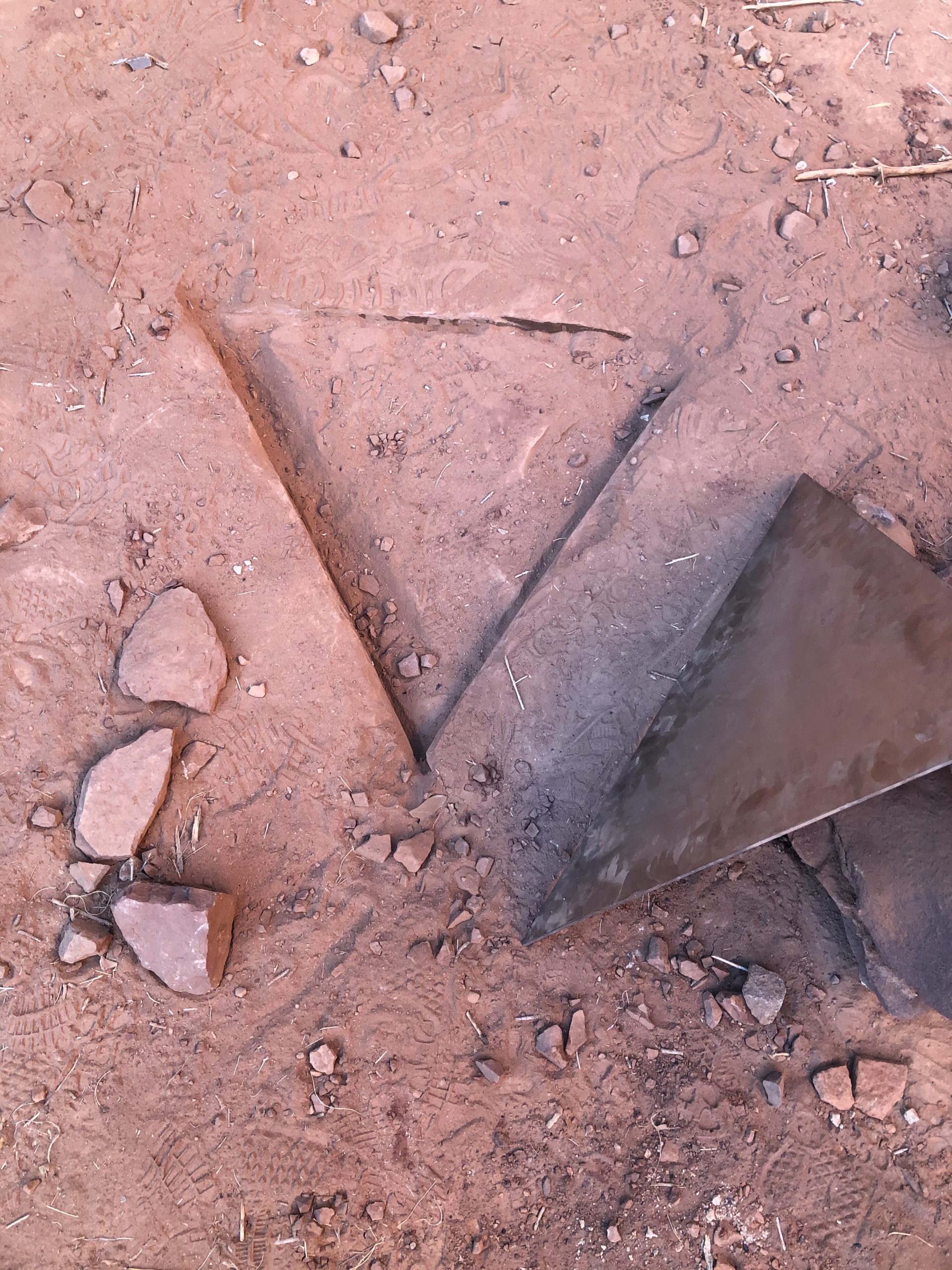
The Bureau of Land Management confirmed that the structure had disappeared that evening and stated that its staff had not removed it. Members of the removal group subsequently spoke publicly, saying they had acted because of the damage caused by the influx of visitors. [1, 3]
The structure was not simply lost from the record. In a later interview, members of the group described rebuilding it and delivering it to the BLM. Video showed it standing again in a yard.
The agency did not confirm possession to the broadcaster at the time. The reported handover therefore belongs to the group’s account, rather than to an independently confirmed official history of the object’s subsequent custody. [4]
The removal had witnesses and people willing to explain their actions. The installation still had neither a verified author nor an account from someone demonstrably responsible.
From the Official Record: 29 November 2020
The BLM’s statement confirmed the removal and distinguished it from the agency’s own actions. It also recorded the effects of the sudden increase in visitors.
For the land managers, the questions extended beyond who had made the object. They concerned an unauthorised structure, a remote site without visitor facilities, and the damage left by people arriving to see it.
Source: Bureau of Land Management, “Illegally installed structure taken from BLM public lands over Thanksgiving weekend,” 29 November 2020.
When One Monolith Became Many
Similar pillars appeared in Romania, California, the Isle of Wight and other locations. The shape had become instantly recognisable.
Some makers acknowledged their work. Some installations were promotional; others were jokes or artistic responses. A metal column could now arrive with a story already attached to it, even if its maker offered no explanation at all.
These later objects do not establish a common author for the Utah pillar. They show how readily an image can become an invitation to imitate it.
The original object had spent years outside widespread public attention. Its successors entered a world already watching for the next one.
What Was It For?
Art offers the clearest interpretation of the deliberate form and setting. The reflective surface changed with the light; the straight edges stood against irregular stone. Yet visual effect alone cannot establish whether the maker intended a serious artwork, a tribute or an elaborate joke.
Publicity is possible. The long interval before widespread discovery makes a conventional launch campaign less obvious, but it does not reveal what the maker expected or whether any original plan changed.
A prank would account for the surprise without explaining much about the effort involved. Materials, tools and labour had to reach the canyon. Whoever undertook that work accepted the possibility that the result might remain little known.
The extraterrestrial interpretation belonged largely to humour and the cultural memory of 2001. It helped the photographs travel. The physical structure, however, supplied ordinary evidence of fabrication and installation.
The most interesting uncertainty survives without requiring the pillar to have come from anywhere beyond Earth. It concerns a human decision whose author has not been reliably identified.
Archive Assessment
The Utah monolith was a real, unauthorised installation. Its presence, construction and removal are documented. Its maker and purpose remain unverified in the record examined for this report.
The original draft of the mystery was written by its setting: a precise metal form in a canyon, with no explanatory label. The public then supplied possible meanings—art, joke, tribute, intrusion—and argued about whether it should remain.
Calling it an anonymous artwork is reasonable. Saying that its creator deliberately planned every stage of its eventual fame would go further than the evidence allows.
There is a quieter question beneath the photographs of crowds and the accounts of its removal. For several years before the world began discussing it, the pillar was already standing there.
What did its maker imagine would happen next?
Archive Classification
Authentic / Unresolved
A documented human-made installation of unverified authorship and purpose. Its construction requires no extraordinary explanation. An artistic intention is plausible, but the surviving evidence does not establish who created it or why.
Key Facts
- Location: BLM-managed public land in San Juan County, Utah, United States.
- Official discovery: 18 November 2020.
- Discovery team: Utah Division of Wildlife Resources and Department of Public Safety Aero Bureau personnel.
- Construction: Hollow, riveted triangular metal pillar.
- Height: Approximately 2.9 metres.
- Earlier presence: Visible in historical imagery by October 2016; published comparisons suggested installation during 2016.
- Removal: Evening of 27 November 2020.
- Unresolved question: Original authorship and intention.
Continue Through the Archive
The Roman dodecahedra present a different kind of silence. Their makers left numerous objects across a large region, but no surviving explanation securely identifies their purpose.
Explore The Roman Dodecahedra: Objects Without an Explanation →
Sources
- Bureau of Land Management — “Illegally installed structure taken from BLM public lands over Thanksgiving weekend.” 29 November 2020. Official statement and photographs documenting the removal and visitor impacts.
- Adi Robertson — “Even Utah’s mysterious monolith may be no match for Google Earth.” The Verge, 24 November 2020. Contemporary reporting on the identification of the site and historical imagery.
- Lindsay Whitehurst — “Athletes say they removed Utah monolith; legal case unclear.” Associated Press, 2 December 2020. Reporting on the people who acknowledged removing the structure.
- FOX 13 Utah — “Monolith from Utah desert given to BLM and could go on display, say men who removed it.” December 2020. Interview with members of the removal group; notes that the BLM did not confirm possession to the broadcaster.
- Deborah Solomon — “Did John McCracken Make That Monolith in Utah?” The New York Times, 27 November 2020. Contemporary discussion of the proposed artistic attribution.
Further Reading
The BLM’s contemporary statement records the land-management side of the story, including the empty installation site and the impact of visitors. Read the official statement.
Arthur C. Clarke — 2001: A Space Odyssey. The novel developed alongside the film whose monolith supplied the immediate cultural comparison. Fiction, included as background to the public response rather than evidence about the Utah installation. Find on Amazon UK.
Image Credits
Utah monolith: photograph by Patrick A. Mackie, dated 26 November 2020 in the source description. Wikimedia Commons source. Licensed under Creative Commons Attribution-ShareAlike 4.0 International. Displayed at reduced size.
Empty installation site: Bureau of Land Management, 28 November 2020. Published with the agency’s statement of 29 November 2020; source record. U.S. federal government work, public domain in the United States. Displayed at reduced size.

Editorial note: historical-image comparisons establish the structure’s earlier presence, not the maker’s intention or whether anyone had encountered it before 2020. The reported later handover to the BLM is attributed to the removal group. Resemblance to an artist’s work is not treated as proof of authorship.