
A complete, concise Archive account. Free to read in full.
North-western Roman Empire · Principally second to fourth centuries CE
About a metre below a Lincolnshire field, the excavators found an object with twelve faces.
It was June 2023. At Norton Disney, in England, a community archaeology team was investigating a Roman site near the remains of a villa. From the soil came a complete copper-alloy object: hollow, pierced with circular openings, its corners finished with small rounded knobs.
Its name was familiar. Its purpose was not.
A Roman dodecahedron. One of a scattered family of objects whose makers repeatedly chose this elaborate form, then left no explanation that we can securely recognise.
Twelve Faces, No Instructions
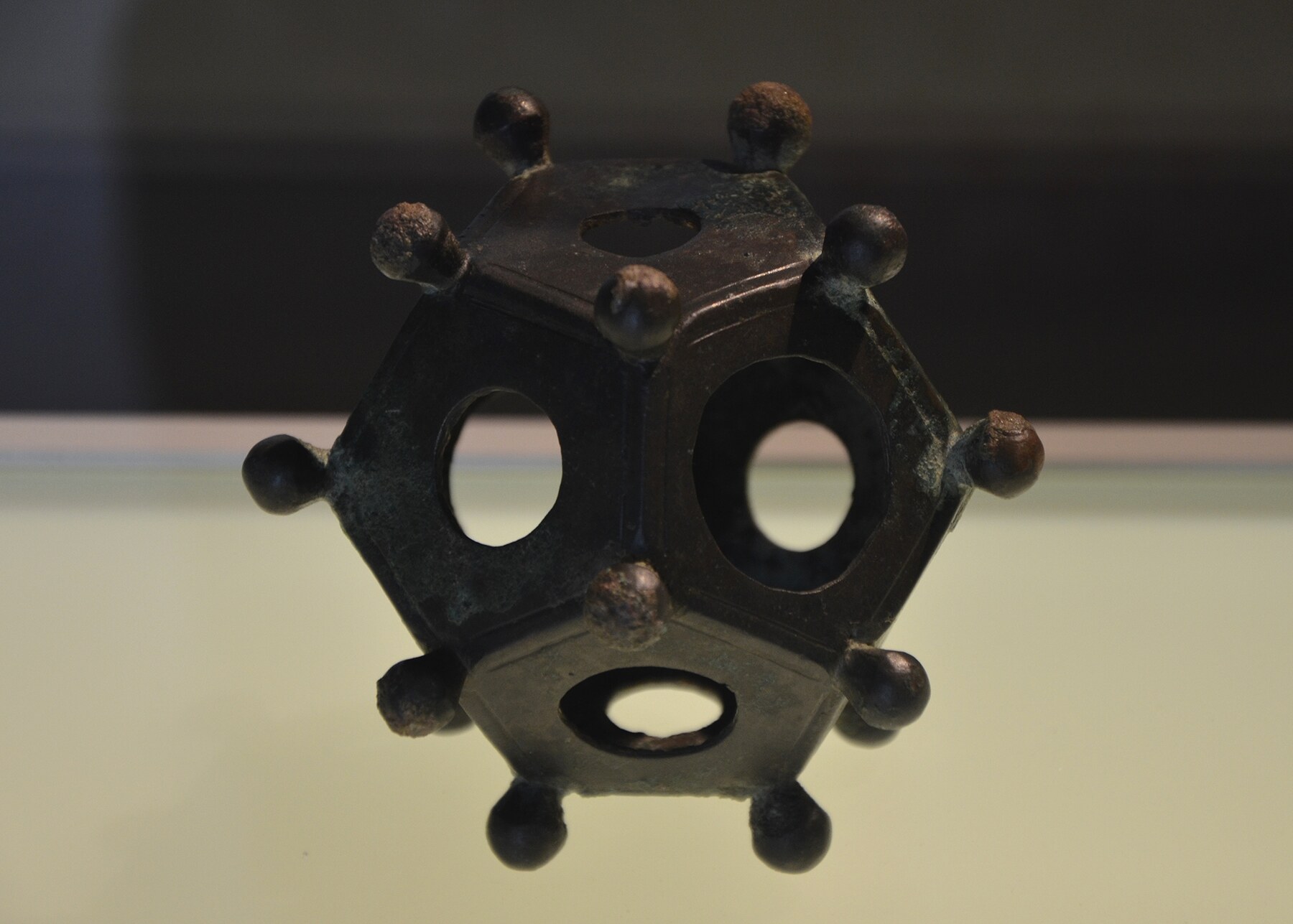
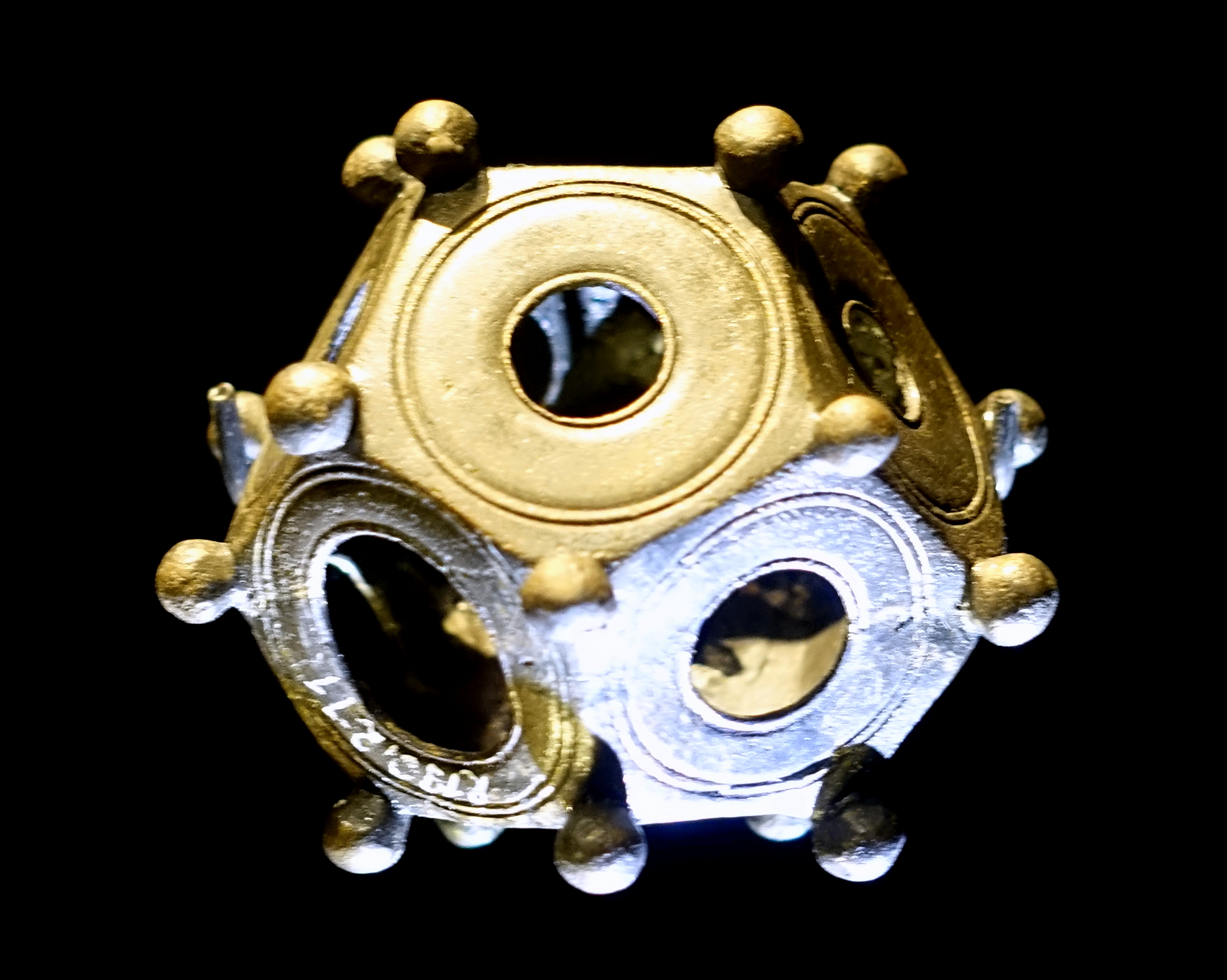
The name describes the geometry: twelve pentagonal faces surrounding a hollow centre. Openings pass through those faces, and twenty knobs stand at the corners.
Turn one in the light and it seems full of practical possibilities. A hole to look through. A knob around which to loop something. A shape which rests securely on several points.
Yet the objects do not conform to a single set of dimensions. Their weights and decoration vary, as do the sizes and arrangements of their openings. Many carry concentric rings around the holes. They do not provide the labelled scales or instructions which might identify a measuring instrument.
Their distribution is distinctive, too. Finds belong predominantly to the northern and western provinces of the Roman Empire, including Britain and areas of modern France, Belgium and Germany. This regional concentration is one reason for the name “Gallo-Roman dodecahedra”.
The pattern suggests a shared practice. It does not reveal what that practice was.
The Missing Context
No accepted ancient description or depiction securely identifies these metal objects in use.
That absence is more difficult to interpret than it first appears. A familiar household or workshop task might not have seemed worth explaining. A ceremonial object might have belonged to knowledge passed between participants. A written account might simply have failed to survive.
The findspots do not supply one consistent setting. Dodecahedra have been recovered from different kinds of Roman sites, while many older discoveries lack the detailed records expected from a modern excavation.
Even a carefully recorded burial place is not necessarily a place of use. An object can be stored, moved, discarded or deposited for reasons quite different from the purpose for which it was made.
The Evidential Divide
What survives: the objects themselves—their metal, construction, dimensions, decoration and, in some cases, their archaeological setting.
What remains missing: a secure connection between that form and a particular Roman activity. A replica can demonstrate what the shape permits; the historical question is what people actually did with it.
Looking Through the Holes
One family of explanations treats the dodecahedron as a measuring or sighting device.
Two openings of different sizes can restrict a field of view. With suitable dimensions and assumptions, that arrangement can be used to investigate distance or size. It is an appealing place to begin because it gives the holes an immediate job.
The difficulty comes when the examples are compared. Their dimensions differ, and there is no surviving calibration system linking one to another. Variation would not make every specialised measuring use impossible, but it leaves the proposed method without its historical instructions.
Other practical suggestions treat the openings as holders or gauges. A candle can be supported; material can be passed through a hole. The question is whether such uses explain the complete design, rather than a single convenient feature.
A Tool for Thread—or Wax?
Modern demonstrations have made the textile suggestion particularly familiar. Yarn looped around the projecting knobs of a replica can form a small tube, inviting comparison with glove-making.
The demonstration is real. The connection to Roman textile production remains unestablished. No associated ancient textile or securely identified working arrangement closes that gap.
A different experiment appeared in the EXARC Journal in May 2026. It explored whether the objects could help form small wax shapes around cords, potentially useful in sealing or identification.
The proposed use gives a role to the faces, openings and knobs. Experiments can test whether the process works and whether its results are repeatable. Establishing that Romans used dodecahedra in this way would require further evidence connecting the surviving objects with the proposed products and activity. [4]
A Shape with Meaning
The twelve-sided form also had a life in ancient philosophy. In Plato’s account of the ordered universe, the dodecahedron occupied a distinctive place.
That association has encouraged interpretations involving ceremony, cosmology and divination. A carefully made object need not have been a tool in the modern sense. It might have represented something, marked an identity or belonged to a particular practice.
A 2025 paper by Michael Guggenberger and Stephen Leach revisited philosophical texts as possible clues to the objects’ inspiration, including a passage in Iamblichus. Its published abstract connects that discussion with the distribution of finds in Gaul and Britain. It does not identify an ancient description of the artefact itself. [5]
The symbolic reading remains worth considering. So does the distinction between recognising a meaningful shape and knowing why someone cast it in metal.
What Norton Disney Added
The Norton Disney discovery offered something many earlier finds lacked: a complete object recovered during a documented excavation.
Specialist Lorena Hitchens described its high-quality casting and excellent preservation. Her report recorded the openings, decoration and small surface features, while recommending further investigation of both the object and its context. [1]
When the team returned in 2024, the pit proved to have been a sand quarry later filled with debris. Pottery and a coin helped establish the chronology of that fill. Further work in 2025 and 2026 placed the find within a wider area of pits, ditches and industrial activity associated with the Roman villa estate. [2]
This is a much richer history than an isolated object without a recorded findspot. It still does not show the dodecahedron at work.
Was it placed in the pit deliberately? Was it discarded? Had it arrived among material brought from elsewhere? The excavation provides the setting in which those questions can be asked, without yet choosing between them.
Inside the Excavation Report
Appendix 7 of the Norton Disney evaluation report contains Lorena Hitchens’s examination of the dodecahedron. It records dimensions, decoration, condition and features attributed to manufacture.
The observations are more specific than the familiar description “unworn”. Distinguishing casting marks, later damage and traces of use requires close examination.
Read the excavation report at the Archaeology Data Service · PDF
Linked source, not reproduced here. The report contains separately copyrighted photographs and illustrations.
Returning to the Metal
There is another route into the mystery: examining how the objects were made and what has happened to their surfaces.
In a report on her doctoral research, Hitchens described work on seven dodecahedra and a rarer twenty-faced object in Germany. Measurements and close inspection were combined with X-rays and analysis of metal composition.
Such work can distinguish features which ordinary photographs conceal. It may reveal patterns of manufacture or use, test assumptions about apparently similar objects, and help establish which comparisons are meaningful. [3]
A proposed explanation may begin with an ingenious replica. Its strongest test still lies with the ancient metal.
Archive Assessment
The dodecahedra are authentic Roman-period artefacts whose purpose remains unresolved.
Practical and symbolic interpretations both have questions to answer. The regional distribution matters, but does not by itself prove a religious function. Variation in dimensions complicates standardised measuring theories, but does not rule out every specialised tool. A successful modern experiment establishes a possibility, not an ancient custom.
The repeated form is what makes the silence so striking. These were not all the work of one eccentric maker. Different people, in different places, invested skill and material in related objects.
At some point, the shape was intelligible. Someone could have picked one up and known what to do next.
Archive Classification
Authentic / Unresolved
A genuine Roman-period artefact tradition with no securely established function. Measuring, craft and symbolic interpretations remain under discussion; none is treated here as a demonstrated identification.
Key Facts
- Period: Principally second to fourth centuries CE.
- Distribution: Northern and western provinces of the Roman Empire.
- Known examples: Around 130 in commonly cited museum accounts; totals depend on the catalogue and inclusion criteria.
- Construction: Hollow cast copper alloy, with twelve perforated faces and twenty corner knobs.
- Typical dimensions: Approximately 4–11 centimetres, varying between examples.
- Norton Disney discovery: June 2023, Lincolnshire, England.
- Status: Ancient manufacture established; purpose unresolved.
Continue Through the Archive
At the Barabar Caves in Bihar, India, the evidence takes a different form: inscriptions, carefully shaped chambers and polished stone surfaces which can still be examined in place.
Explore The Barabar Caves: The Polished Enigma →
Sources
- Lorena Hitchens — “Roman Dodecahedron,” Appendix 7 in Allen Archaeology Limited, Archaeological Evaluation Report: Land at Brills Farm, Norton Disney, Lincolnshire, March 2024. Archaeology Data Service; OASIS reference allenarc1-521355.
- National Civil War Centre, Newark — “Norton Disney Dodecahedron.” Includes an account by Richard Parker of the Norton Disney History and Archaeology Group and the results of work through 2026.
- Lorena Hitchens — “Harnessing Archaeological Science to Investigate Roman Dodecahedra.” British Archaeological Association, 2025 award report. Account of examination, imaging and materials analysis.
- “A Functional Reassessment of Roman Dodecahedra as Tools for Forming Standardised Wax Objects.” The EXARC Journal, issue 2026/2, 29 May 2026. Experimental hypothesis; not treated as an established function.
- Michael Guggenberger and Stephen Leach — “The Gallo-Roman Dodecahedron and the Receptacle of All Becoming.” The Antiquaries Journal, volume 105, 2025, pp. 31–54. DOI: 10.1017/S000358152510036X. Published abstract consulted for the interpretation summarised here.
- Newcastle University — “Newcastle student investigates Roman 12-sided ‘mystery objects’.” 9 January 2024. Research context and commentary by Lorena Hitchens.
Further Reading
Current research: Hitchens’s British Archaeological Association report explains the laboratory and observational work being undertaken on the objects.
Experimental archaeology: the 2026 EXARC article sets out the wax-forming proposal and its experimental approach.
Guy de la Bédoyère — Roman Britain: A New History. Wider historical background. Find on Amazon UK.
Image Credits
Tongeren dodecahedron: photograph by Carole Raddato, licensed under CC BY-SA 2.0. Resized for web presentation.
Stuttgart-Bad Cannstatt dodecahedron: photograph by Daderot, released under the CC0 1.0 Universal Public Domain Dedication. Landesmuseum Württemberg, Stuttgart, Germany. Resized for web presentation.
Editorial note: proposed functions are distinguished from established archaeological findings. The museum’s current excavation summary supports the discussion of work through 2026. The 2025 philosophical interpretation is summarised from its published abstract; its full argument has not been represented as independently assessed here.