Key Facts
- Location: Guyra, New South Wales, Australia.
- Period: April 1921, with subsequent reports from Glen Innes.
- Household: William Bowen and his family, including twelve-year-old Minnie.
- Reported disturbances: stone impacts, broken windows and heavy knocks on the walls.
Men waited outside the cottage while others watched the family indoors. When the knocks came, each group could believe they had started on the other side of the wall.
For several weeks in April 1921, people returned to the Bowen home outside Guyra, in New South Wales. They brought torches, guns and ideas about what was happening. Stones struck the timber walls. Windows broke. Searches followed.
By the end of the month, newspapers were announcing that the Guyra ghost had been caught.
Then came reports of more stones.[2][3][4][5]
The Cottage Outside Guyra
William Bowen worked for the local shire as a ganger, in charge of a work crew. His family lived in a small weatherboard cottage on the outskirts of the farming town. Early in April, reports of stone-throwing and heavy knocking brought neighbours and police to the house.
Much of their attention fell on twelve-year-old Minnie Bowen. Stones were said to come through her bedroom window and land on her bed. As the disturbance became known, the watches grew. Contemporary reports describe dozens of people taking positions around the building.
They did not all see the same things. Some heard knocks without finding anyone near the wall. Some attended on nights when nothing happened. The newspaper accounts brought these different experiences together into the story of a house that seemed able to defeat every guard.[2][5]
A Message from Her Sister
A visitor from Uralla thought the knocking might be a form of communication. The Sydney Morning Herald of 15 April describes his attempt to find out.
Minnie stood near the wall, in a room faintly lit from the adjoining room. Her mother was there, with Constable Taylor and other men. The visitor asked her to address a sister who had died a few months before.
At first, according to Taylor’s account, Minnie objected that her sister was not there. Then she asked the question and said she had received an answer. Her sister was happy in heaven. She would look after their mother.
The replies came through Minnie’s account of what she heard. The newspaper did not describe a voice audible to everyone present. When she repeated the message to a larger gathering in the dining room, her mother and other family members were deeply affected.[1]
For those who accepted it, grief had supplied a meaning for the disturbance. Another visitor, H. J. Moors, favoured a poltergeist: a noisy, disruptive agency, rather than necessarily the spirit of the dead sister.[2]
The Watch That Found Someone
The police continued to look for a person throwing stones. Constable Hardy was sent from Sydney. In the statement later reproduced by newspapers, he heard two impacts during his stay. On a subsequent watch, a local farmer named Mr Starr saw a girl throw several stones at the cottage.
Starr told the police. They questioned Minnie, who initially denied throwing stones that day. Confronted with Starr’s account in her parents’ presence, she admitted it. The published statement also said she had made knocks by striking the inner walls with a stick while people watched outside.
There was an explanation here for at least part of what the watchers had heard. The girl inside the house had sometimes been making the noises that drew attention to it.
But the admissions were not reported consistently. The Star of Christchurch, reprinting Sydney coverage on 3 May, described a girl admitting some knocks and small stones thrown onto the roof, while denying responsibility for larger stones or any arrangement with other people. Police believed several people had contributed. One theory in the coverage was that someone wanted possession of the house; it remained a suspicion.
The short headline announced a confession. In the longer account, a limited admission sat beside a much wider police explanation.[3]
Another House, More Knocking
A dispatch from Sydney dated 30 April reported renewed stone-throwing at Guyra while Minnie was indoors. The story had continued beyond its announced solution.
She went to stay with her grandmother, Mrs Shelton, in Glen Innes. Reports from there described another broken window and knocks whose source a constable could not confidently place. To people who believed the disturbance centred on Minnie, the change of address seemed to strengthen their case.
Yet the Glen Innes reporting also carries a familiar accusation. A farmer visiting the house said he saw Minnie bump the wall with her elbow. She denied having done so. The police warned her, and the report describes a quiet remainder of that night.[4]
Each new incident could be read in more than one way. A girl indoors might be watched while someone outside threw a stone. A sound with no visible source might be treated as another trick or another manifestation. The accounts leave us without the continuous observation needed to decide what happened on every occasion.
What the Watchers Believed
The proposed explanations ranged from a few local pranksters to an agency beyond the living. One contemporary report even mentioned a suggestion that the stones themselves had become explosive, though no test or physical evidence for that idea was supplied.[2]
Later poltergeist writers have suggested that Minnie might have been the unconscious source of a force she could not control. That interpretation gives a different meaning to the way the trouble seemed to follow her. It remains a proposal about the reports, rather than a demonstrated ability.[7]
Deliberate acts, outside interference and the growing excitement could also have combined. Once crowds arrived, there were more people near the house and more opportunities for a noise to be heard, repeated and discussed. That possibility does not require every witness to have invented what they experienced.
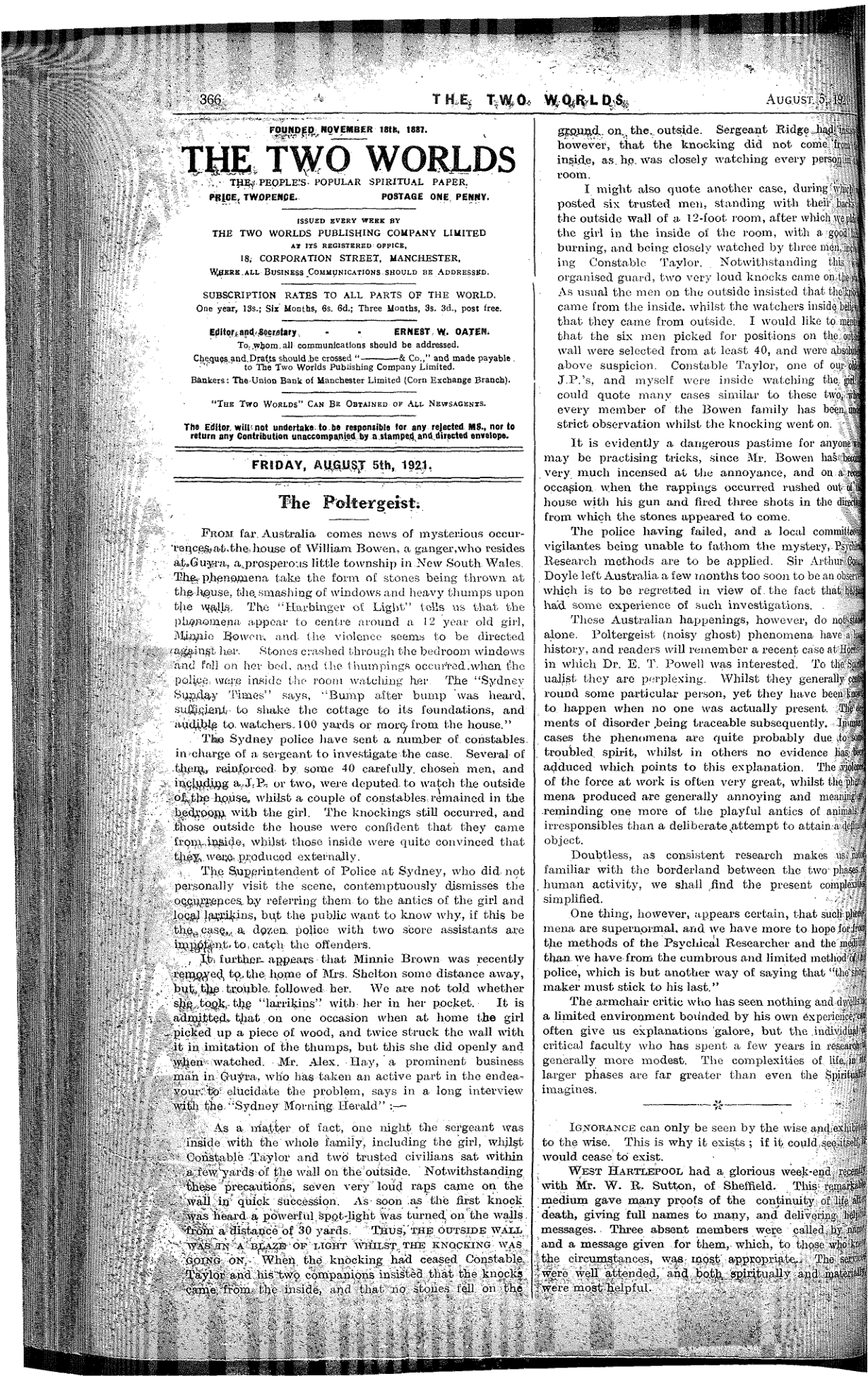
In August, The Two Worlds presented the case to its Spiritualist readers. Its argument returned to the watches: people had been observed, it said, while blows continued. How could the police explanation account for those occasions? The journal acknowledged a small-stone admission but considered it inadequate to explain the whole affair.[5]
By then, the cottage had also become the subject of a film. John Cosgrove’s The Guyra Ghost Mystery turned the episode into screen entertainment in 1921.[6]
The surviving record contains both a child said to have admitted tricks and adults who remained convinced that they had witnessed more. For Minnie, the attention placed her at the centre of a story told by police, neighbours, visitors and newspapers. Her own words reach us through their accounts.
For a few weeks, people had gathered on either side of the cottage walls, each relying on the others to watch what they could not see. The lasting question is how much escaped those watches, and how much was added as the story passed between them.
Archive Assessment
Evidentially Limited
Contemporary newspapers report direct observation of stone-throwing and admissions to deliberate acts. They also record incidents those admissions did not fully explain. The remaining uncertainty concerns the extent of the activity and who caused it; a paranormal cause has not been established.
Read the Contemporary Sources
Two documents preserve different parts of the story: the newspaper coverage of the messages, admissions and later incidents, and a Spiritualist journal’s argument that the case remained unexplained.
Contemporary Press Reader
Three pages of selected 1921 newspaper passages, with source details and brief reading notes.
A modern reading edition, not newspaper facsimiles. Archive OCR has been normalised; original page images were not available for a word-by-word comparison.
The Original Journal Page
“The Poltergeist”, The Two Worlds, 5 August 1921, p. 366. One complete scanned page.
Extracted from the issue digitised by IAPSOP. The source page is unaltered and retains its original scan defects.
Sources
- The Sydney Morning Herald, 15 April 1921, p. 9, “Guyra Mystery. Little Girl’s Statement. Clairaudient Messages.” Trove article text examined; distinguishes the prompted exchange and claimed messages from an independently audible voice. Source.
- Gisborne Times, 23 April 1921, p. 5, “Guyra Ghosts.” Contemporary dispatches describing watches, H. J. Moors’s poltergeist interpretation and the explosive-stone suggestion. Archive-indexed text examined. Source.
- Star (Christchurch), 3 May 1921, p. 7, “The Guyra Ghost.” Reprints Sydney coverage and a statement attributed to the Inspector-General of Police. Used for the reported observation, admissions and their stated limits; this is not an original signed police file. Archive-indexed text examined. Source.
- Ashburton Guardian, 2 May 1921, “Australian News”, Sydney dispatch dated 30 April; Wanganui Herald, 19 May 1921, p. 6, “The Guyra ‘Ghost’”; and Wanganui Chronicle, 20 May 1921, p. 6, “Guyra Stone-Thrower.” Used for subsequent reports and the renewed allegation of deliberate knocking. Publication dates and event dates differ; the Glen Innes sequence is not treated as securely reconstructed. Ashburton report; Herald report; Chronicle report.
- The Two Worlds, 5 August 1921, p. 366, “The Poltergeist.” Original scan examined. Contemporary Spiritualist reception drawing on Australian reports; not an independent investigation by this journal. Read the source page.
- National Film and Sound Archive of Australia. “A Survey of Australian Horror Films from the 1970s to Saw and The Babadook.” Identifies The Guyra Ghost Mystery (1921) among early films touching on supernatural themes. Source.
- Paul Cropper. “The Guyra Ghost of 1921” (2023). Used as evidence of a later poltergeist interpretation, including the proposed unconscious role of Minnie; not independent verification of that mechanism. Source.
Further Reading and Listening
Daniel Best’s Mystery, Myth & Misdirection: Hunting the Guyra Ghost (2020) offers a longer investigation. Only its catalogue description was assessed for this report. MonsterTalk episode 207 discusses Karen Stollznow’s research, while Paul Cropper’s account presents a poltergeist interpretation. The complete book and podcast audio were not assessed here.
Continue Through the Archive
Explore more Paranormal Encounters, or return to the Archive Index.