
A complete, concise Archive account of a documented incident and the story that grew around it.
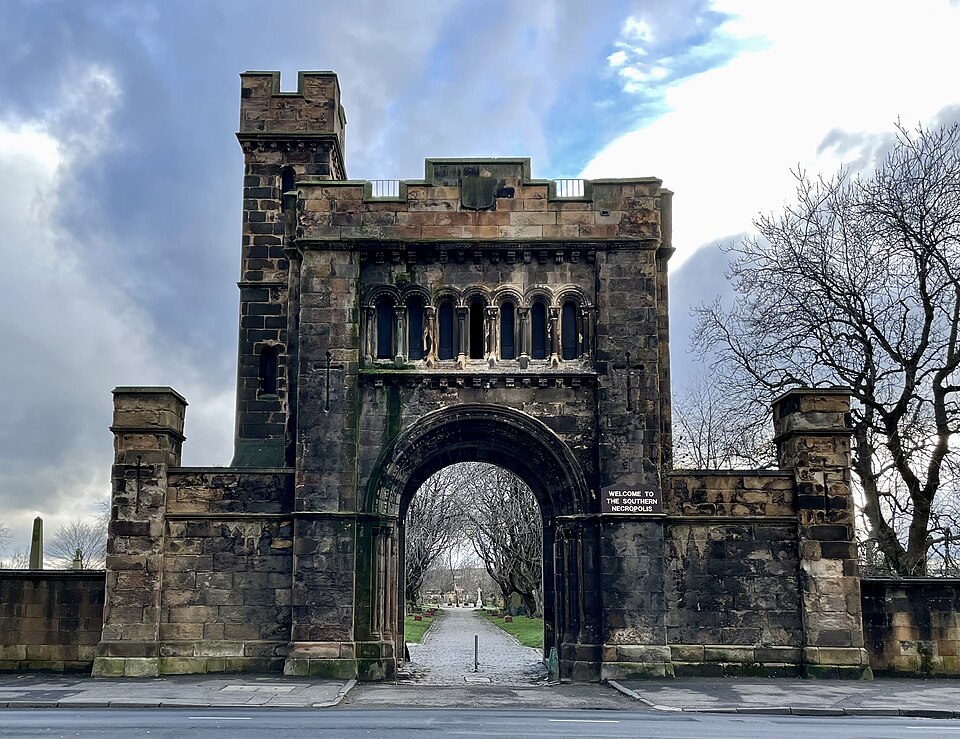
Southern Necropolis, Gorbals, Glasgow, Scotland · September 1954
Complete and free to read
The police were called because of the noise.
After school on 23 September 1954, children had begun gathering at Glasgow’s Southern Necropolis. Some carried sticks. Others had stones. More kept arriving.
They were looking for something said to be hiding among the graves.
It had iron teeth. It had killed and eaten two boys.
When Constable Alex Deeprose arrived, the children followed him, talking at once about the vampire. By the next morning, their search had reached the front page of The Bulletin.
The hunt was real. The story that had brought them there was much harder to trace.
Into the Cemetery
The earliest substantial report appeared on 24 September 1954.
Malcolm Nicolson, a crime reporter, had learned of the incident through the local police station. His account described children entering the cemetery and searching the grounds, while nearby residents complained about the clamour.
Deeprose found himself surrounded by young searchers eager to explain what they had come to destroy.
As darkness fell, the gathering began to thin. Rain brought the search to an end.
There were reports of children returning the following evening. The story had acquired a place to go, and the absence of a creature on the first visit had not immediately exhausted it. [1, 2]
Two Boys Without Names
The rumour contained an apparent reason for urgency: two children had already been eaten.
Yet the surviving reporting provides no identified victims whose deaths substantiate that claim. Nor does it establish a witnessed attack in the cemetery.
The monster reached the record through what the searchers said about it. The police officer and reporter could describe the gathering; neither supplied evidence of the creature.
This leaves an unusual balance. There is a named officer, a named reporter, a dated newspaper account and a recognisable place. The event is well enough anchored. At its centre is a story whose first teller remains unknown.
The Evidential Divide
Documented: children searched the Southern Necropolis; police attended; newspapers reported an iron-toothed vampire rumour.
Unsubstantiated: a vampire in the cemetery, two children killed by it, or a single demonstrated source for the rumour.
The Adults Find an Explanation
The original report ended with a brief reference to a horror film shown locally.
It did not mention comics.
That emphasis changed as the story travelled. Britain already had a campaign against horror comics, and the Glasgow hunt became an example in the argument about their effect on children.
Folklorists Sandy Hobbs and David Cornwell later compared the coverage and interviewed both Nicolson and Deeprose. They traced how a possible influence became an increasingly confident explanation.
The certainty grew more quickly than the evidence connecting a particular publication to the children’s expedition.
A story about a cemetery gathering had become a story about dangerous reading. [2]
The Vampire Reaches Westminster
On 22 February 1955, the incident was discussed in the House of Commons during debate on the Children and Young Persons (Harmful Publications) Bill.
John Rankin, MP for Glasgow Tradeston, retold the rumour and the children’s attempt to destroy the monster. Roy Jenkins had earlier questioned how confidently particular behaviour could be attributed to what people read.
The disagreement was part of the contemporary debate. Doubt about the proposed connection is not something introduced only by later historians.
The Bill became law in 1955. The Gorbals hunt formed part of the argument surrounding it, but the campaign was already under way. The story’s presence in Parliament does not establish that it caused the legislation—or that comics caused the hunt. [2, 3]
From the Parliamentary Record · 1955
“this vampire had iron teeth and had eaten two young children.”
John Rankin, House of Commons, 22 February 1955, recounting the rumour during debate on harmful publications.
The passage records what an MP told the House about the children’s belief. It is not confirmation of an attack.
Read the parliamentary record. Search the page for “vampire” to find the passage.
Contains Parliamentary information licensed under the Open Parliament Licence v3.0.
Jenny Was There Before
Iron teeth already belonged to an older world of Scottish childhood fears.
In Alexander Anderson’s poem “Jenny wi’ the Airn Teeth”, published in 1879, a mother tries to settle a wakeful child. Jenny is summoned to take the little one away.
The threat becomes a sound outside: heavy footsteps, a presence at the door, the latch lifting.
Then the mother changes sides. Her own child is sleeping safely now. Jenny must go elsewhere.
The poem offers no evidence that the Glasgow children had read it. What it preserves is an earlier use of the same disturbing image: an iron-toothed being invoked by adults to frighten children into obedience. [2, 4]
Read the complete poem: Jenny wi’ the Airn Teeth
Alexander Anderson (1845–1909)
What a plague is this o’ mine,
Winna steek an e’e;
Though I hap him o’er the heid,
As cosy as can be.
Sleep an’ let me to my wark—
A’ thae claes to airn—
Jenny wi’ the airn teeth,
Come an’ tak’ the bairn!
Tak’ him to your ain den,
Whaur the bogie bides,
But first put baith your big teeth
In his wee plump sides;
Gie your auld gray pow a shake,
Rive him frae my grup,
Tak’ him whaur nae kiss is gaun
When he waukens up.
Whatna noise is that I hear
Coomin’ doon the street?
Weel I ken the dump, dump,
O’ her beetle feet;
Mercy me! she’s at the door!
Hear her lift the sneck;
Wheesht, an’ cuddle mammy noo,
Closer roun’ the neck.
Jenny wi’ the airn teeth,
The bairn has aff his claes;
Sleepin’ safe an’ soun’, I think—
Dinna touch his taes.
Sleepin’ bairns are no for you,
Ye may turn aboot,
An’ tak’ awa’ wee Tam next door—
I hear him screichin’ oot.
Dump, dump, awa’ she gangs
Back the road she cam’,
I hear her at the ither door,
Speirin’ after Tam;
He’s a crabbit, greetin’ thing—
The warst in a’ the toon,
Little like my ain wee wean—
Losh, he’s sleepin’ soun’!
Mithers hae an awfu’ wark
Wi’ their bairns at nicht,
Chappin’ on the chair wi’ tangs,
To gie the rogues a fricht;
Aulder bairns are fleyed wi’ less,
Weel eneuch we ken,
Bigger bogies, bigger Jennies,
Frichten muckle men.
A few Scots words: airn means iron; bairn, child; claes, clothes; sneck, door latch; fleyed, frightened.
Public-domain poem. Text follows the printing in The Home Book of Verse, volume I, edited by Burton Egbert Stevenson. Scots spellings retained.
A Story That Draws Children In
A bogeyman is usually meant to keep children away from something: a dangerous place, a forbidden activity, the world beyond the door after dark.
At the Southern Necropolis, the rumour had the opposite effect.
The children went towards the danger. They gathered companions and took things with which to confront it.
Hobbs and Cornwell compared the Glasgow episode with other accounts of children setting out to find feared or mysterious figures. The hunt could be understood within children’s shared storytelling and play, without assuming that everyone present believed precisely the same thing.
Fear, curiosity and the excitement of joining others need not have been separate experiences.
That does not recover the first conversation in which the Gorbals creature appeared. It leaves room for several influences—older threats, films, comics and playground invention—without claiming to know the route by which they met. [2]
Evidence Assessment
| Evidence | What it supports |
|---|---|
| September 1954 reporting | A real gathering of children searching for a supposed vampire, with police attendance. |
| Later interviews | Further context from the reporter and officer, recorded after the event. |
| The parliamentary debate | The story’s use in the dispute over harmful publications; not proof of the rumour’s origin. |
| Earlier iron-toothed figures | A pre-existing folklore motif. No documented chain connects a particular example to the hunt. |
| The alleged victims and creature | No substantiated deaths or verified creature are established by the sources examined. |
Archive Assessment
The Gorbals Vampire survives because something did happen in the cemetery.
A story moved between children, brought them together and prompted a police response. Newspapers then carried it into an adult argument about fear, influence and the things young people should be permitted to read.
The surviving evidence does not establish a vampire or its supposed victims. Nor does it identify a single source from which the rumour began.
Its strangeness lies in that passage from words to action. A creature without a verified sighting could still draw a crowd to a particular place.
Rain ended the first night’s search. The story travelled on.
Archive Classification
Unsupported
Applies to the claim that an iron-toothed vampire killed two children. The cemetery hunt itself is documented. The origin and transmission of the rumour remain questions about the history of the legend.
Key Facts
- Location: Southern Necropolis, Gorbals, Glasgow, Scotland.
- Principal hunt: 23 September 1954.
- First substantial report: The Bulletin, 24 September 1954.
- Reported belief: An iron-toothed vampire had killed and eaten two boys.
- Established event: Children searched the cemetery and police attended.
- Later significance: The incident entered the public debate over horror comics.
- Unresolved question: How did this particular rumour begin and spread?
Continue Through the Archive
For an older account in which an extraordinary story survives through the people who recorded it, continue with The Green Children of Woolpit. Its introduction is free to read; the complete investigation is available to Archive members.
Sources
- The Bulletin, 24 September 1954, “Police Had to Clear ‘Vampire’ Hunters”, p. 1. Contemporary report reproduced in Hobbs and Cornwell, below.
- Sandy Hobbs and David Cornwell, “Hunting the Monster with Iron Teeth”, in Gillian Bennett and Paul Smith, editors, Monsters with Iron Teeth: Perspectives on Contemporary Legend, volume III, 1988, pp. 115–137. Newspaper analysis, interviews and folklore comparisons. Read the research paper.
- House of Commons, 22 February 1955, debate on the Children and Young Persons (Harmful Publications) Bill, Hansard. Contributions by Roy Jenkins and John Rankin. Official parliamentary record.
- Alexander Anderson, “Jenny wi’ the Airn Teeth”, published in Ballads and Sonnets, 1879. The text reproduced here follows The Home Book of Verse, volume I, edited by Burton Egbert Stevenson, available through Project Gutenberg.
Further Reading
The International Society for Contemporary Legend Research lists the Perspectives on Contemporary Legend volumes, including Monsters with Iron Teeth, for readers interested in the wider study of circulating legends.
Image and Text Credits
Header photograph: “Glasgow’s Southern Necropolis gatehouse”, AlistairMcMillan, 10 March 2022. Wikimedia Commons, CC BY-SA 4.0. Displayed at reduced size.
Poem: Alexander Anderson (1845–1909), “Jenny wi’ the Airn Teeth”. Public-domain text; historical Scots spelling retained.
Parliamentary extract: contains Parliamentary information licensed under the Open Parliament Licence v3.0.
Editorial note: the report distinguishes the documented hunt from the claims that prompted it. The research paper is linked for reading; its availability online is not presented as permission to republish its text, newspaper facsimiles or other illustrations.