Online circulation, 2026 · An alleged worldwide weather-control network
Complete and free to read
The announcement begins at the end of a secret war.
Twenty-two stations have fallen. Six nations have acted together. After forty-seven years, a hidden system capable of directing disasters has supposedly been taken out of private hands.
There is no photograph of the final raid. No location is given for the station. The people who seized it remain unnamed.
What survives is a story on a screen.
It calls the programme “Climate Throne”. Elsewhere, the words appear in the opposite order. Behind the name lies an extraordinary allegation: hurricanes, droughts and even earthquakes have been manufactured, while the people beneath them believed they were experiencing nature.
The account offers an ending before it offers evidence. The machinery has been captured. The danger has passed.
To understand its appeal, though, the search leads away from the supposed stations—and into a much older collection of documents.
A Story Without a Station
A version published on Holly’sWorld2.0 on 26 May 2026 is explicitly labelled as copied material. It contains the twenty-two stations, the forty-seven years and the claim that a multinational operation has seized the final installation.
This establishes a dated example of circulation, not the story’s first appearance or its original author.
The account also claims that signals preceded Hurricane Katrina and the earthquakes in Haiti in 2010 and Japan in 2011. No recordings accompany those assertions. There are no instrument details, station coordinates or documents identifying the alleged operation. [1]
Its accusation against the Rothschild family draws on a longstanding antisemitic conspiracy tradition: a Jewish banking family imagined as the hidden director of world events. The material examined supplies no evidence connecting the family to the alleged system. [1, 7]
The programme’s history, personnel and equipment remain outside the frame. Yet one part of the background is genuine.
Governments have tried to make rain.
Rain Over the Supply Routes
On 13 January 1967, a memorandum reached U.S. Secretary of State Dean Rusk. Its subject was weather modification in North Vietnam and Laos: Project Popeye.
It described cloud-seeding trials and a proposal to interfere with military supply routes by increasing rainfall. Officials considered the tests successful, but could not reliably predict the quantity of rain or the full area affected.
The memorandum also anticipated a different consequence of disclosure. Once the operation became known, people might blame the United States for floods and unusual weather it had not caused.
Here was the possibility of a rumour considered before it spread: a real secret programme casting a shadow larger than its demonstrated reach. [2]
The subsequent operations were described to a Senate subcommittee in March 1974. Department of Defense officials reported a rainmaking programme conducted in Southeast Asia from 1967 to 1972, using aircraft to release silver and lead iodide seeding units.
The intended effects were practical and destructive: waterlogged roads, difficult river crossings and disruption to the movement of supplies.
The briefing included maps, dates and expenditure figures. It also contained an admission:
“The results of the project cannot be precisely quantified.”
There were too few ground stations to measure the outcome adequately. Officials believed the operation had increased rainfall and impeded supplies, but their assessment carried that uncertainty with it. [3, pp. 87–103]
How to Wreck the Environment
The same Senate volume contains a more disturbing discussion.
Scientists and officials were considering whether environmental processes might become weapons on a much larger scale. Storms, droughts, earthquakes and changes to polar ice entered the debate. An attack might be concealed within an event that appeared natural.
Gordon J. F. MacDonald, a former member of the Council on Environmental Quality, argued for international restrictions. His earlier essay, reproduced in the hearing, carried the title How to Wreck the Environment.
Read in isolation, some passages sound like disclosures. In context, they are proposals, projections and warnings about what might become possible. MacDonald was pressing for action before such possibilities developed further.
The unease is real. So is the difference between imagining a weapon and demonstrating one.
Within a single bound volume sit an account of actual military rainmaking, experimental research and speculation about far more ambitious interventions. A reader can turn from one to another in a few pages. The evidence does not make the same journey. [3, pp. 50–66, 87–123]
The Hurricane That Changed by Itself
Another programme offers a quieter complication.
Project Stormfury, conducted between 1962 and 1983, investigated whether seeding could weaken hurricanes. The proposed mechanism involved encouraging a new ring of convection outside the eyewall, redistributing the storm’s strongest winds.
Some early observations looked encouraging. Winds weakened after certain experiments.
Later research showed that unmodified hurricanes could undergo similar changes naturally. Hurricanes also contained too much existing ice and too little supercooled water for the proposed seeding mechanism to offer much prospect of success.
The researchers had encountered a difficult problem: a storm could behave as they hoped without having changed because of anything they had done. [4]
The Antennas in Alaska
HAARP supplies the modern story with another recognisable name.
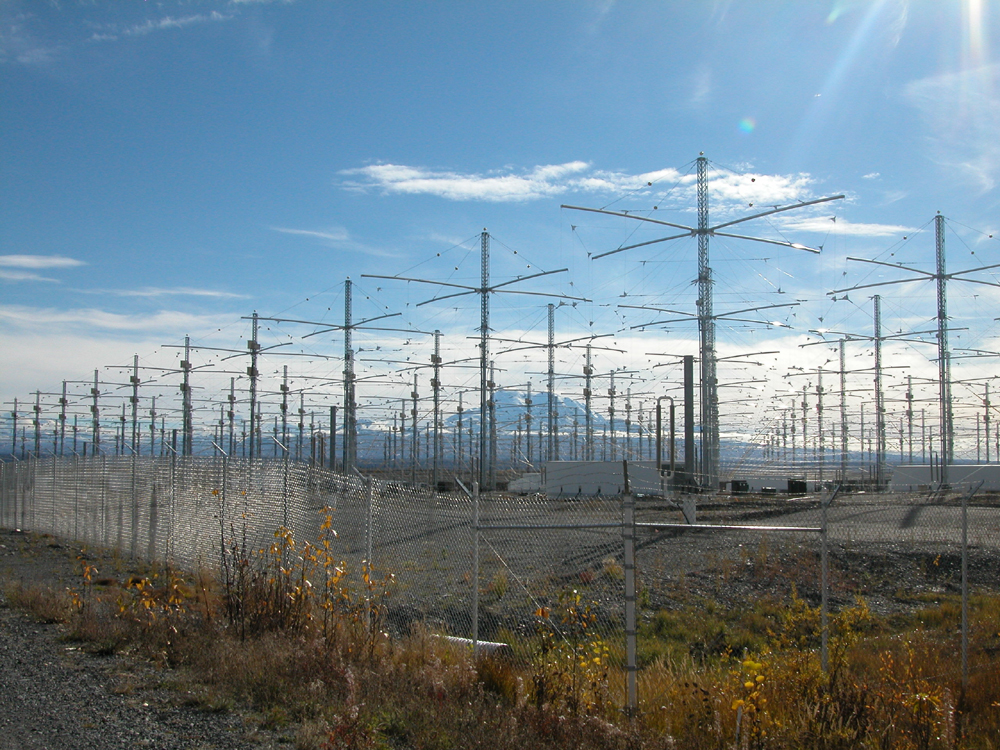
Its antenna field stands in Alaska, United States. The facility studies the ionosphere, an electrically charged region high above the weather-bearing lower atmosphere.
The University of Alaska Fairbanks explains that HAARP’s transmission frequencies do not interact with the lower atmosphere in a way that could control weather. The facility’s existence establishes ionospheric research, not the alleged capacity to steer hurricanes. [5]
Cloud seeding belongs to a different process. It introduces particles into suitable existing clouds to influence their development.
The World Meteorological Organization recognises evidence of effectiveness for particular methods and conditions, including certain wintertime cloud-seeding applications. It also rejects claims of dramatic, large-scale control over weather systems. Success in one kind of cloud cannot simply be extended to a hurricane. [6]
The earthquake claims require a further explanation altogether: how the alleged equipment would cause movement along a fault, and what measurements connect it to a particular event. The circulating account provides neither.
A Modern Weather Legend
“Climate Throne” gives disasters a common author.
Floods, storms and earthquakes cease to be separate events. They become the work of a single concealed system, followed by a final operation that restores order.
That structure gives the story its place among modern legends. There are hidden rulers, powers withheld from ordinary people and unnamed rescuers who arrive after decades of harm.
Its machinery is contemporary. Its promise is familiar: behind events that seem arbitrary, somebody knows what is happening.
The historical documents complicate the story without confirming it. Weather warfare was attempted. Officials concealed operations. Scientists imagined interventions that extended well beyond anything demonstrated in the field.
What remains missing is the bridge from those records to these twenty-two stations.
From the Original Record
The Documents Behind the Weather-Warfare Debate
The 1967 memorandum and the 1974 Senate hearing provide two different views: a proposal circulated within government, and the later examination of operations and their implications.
Read the 1974 Senate Hearing · PDF
Both links lead to official U.S. government repositories. The Senate PDF is approximately 23 MB. Its references below use the printed page numbers, which differ from the PDF viewer’s page count.
Where to look in the documents
- 1967 memorandum, paragraphs 2–4: the trials in Laos, officials’ assessment and uncertainty over the area and volume of rainfall.
- 1967 memorandum, paragraph 13: anticipated publicity and the possibility of being blamed for unrelated weather events.
- 1974 hearing, printed pages 50–55: MacDonald’s testimony and discussion of possible environmental weapons.
- Printed pages 55–66: the reprinted essay How to Wreck the Environment.
- Printed pages 87–103: the Department of Defense briefing, programme charts and operational maps.
- Printed page 103: the qualification that the programme’s results could not be precisely quantified.
The Senate volume is linked as a research source. It includes previously published material by outside authors; availability through a government repository does not establish unrestricted reuse of every item within it.
Evidence Assessment
| Record or claim | What it supports |
|---|---|
| The circulating account | A documented example of a modern online narrative. The copy examined supplies no independently checkable evidence for its alleged network. |
| Project Popeye documents | A genuine military cloud-seeding programme, with stated uncertainty over the size of its effects. |
| MacDonald’s testimony and essay | Historical concern about possible environmental weapons. Discussion of a possibility does not establish an operational capability. |
| Project Stormfury | Actual hurricane-modification experiments whose apparent successes were undermined by later understanding of natural storm behaviour. |
| HAARP | A real ionospheric research facility. No demonstrated connection to the alleged network or disaster-control capabilities. |
| Twenty-two stations and their seizure | No station inventory, operational records or independently verifiable seizure evidence in the material examined. |
Archive Assessment
The history behind this claim is substantial. The evidence for the claim itself is not.
“Climate Throne” remains an unsupported account of a worldwide disaster-control system. Its references to real experiments do not establish its stations, ownership or supposed capture.
Nor does the absence of supporting evidence identify the first person who wrote it. The dated copy examined here preserves a stage in its circulation; it does not settle its origin.
The more unsettling record lies in the earlier documents. Officials were willing to attempt secret weather modification while acknowledging uncertainty over its effects. They also understood that, once discovered, such an operation could leave suspicion behind long after the aircraft had stopped flying.
In the modern story, that suspicion has become certainty. The machines are hidden, their reach is global, and every disaster has an explanation.
But the final station—the one whose capture supposedly ended it all—still has no address.
Archive Classification
Unsupported
The examined account provides no verifiable evidence for its twenty-two stations, alleged disaster signatures or multinational seizure. Historical weather-modification operations are documented; the “Climate Throne” network is not established by those records.
Key Facts
- Names: “Climate Throne” and “Throne Climate”.
- Circulation: Documented online in 2026; a dated copy examined here was published on 26 May.
- Central allegation: Twenty-two installations controlling disasters over forty-seven years.
- Documented historical background: Project Popeye, Project Stormfury and congressional discussion of environmental warfare.
- Unestablished: The alleged network, its operators, its effects and its seizure.
Continue Through the Archive
Elsewhere in the Archive, instruments, photographs and surviving documents offer other ways into an unfamiliar event.
Sources
- Holly’sWorld2.0, “Climate Throne,” 26 May 2026. A dated example explicitly labelled as copied material. Cited as evidence of the narrative’s circulation, not as verification of its allegations.
- Foy D. Kohler to Dean Rusk, “Weather Modification in North Vietnam and Laos (Project Popeye),” 13 January 1967. Foreign Relations of the United States, 1964–1968, volume XXVIII, document 274. U.S. Department of State, Office of the Historian.
- U.S. Senate, Weather Modification, 1974. Hearings before the Subcommittee on Oceans and International Environment, Committee on Foreign Relations, 25 January and 20 March 1974. Government Printing Office. Particular references: printed pages 50–66 and 87–123.
- NOAA, Hurricane Research Division, “Project Stormfury”. Programme summary explaining the proposed mechanism and the later reassessment of apparent experimental successes.
- University of Alaska Fairbanks, HAARP Frequently Asked Questions. Facility purpose and explanation of why its transmissions cannot control weather.
- World Meteorological Organization, “Statement on Weather Modification,” 14 June 2025. Scientific assessment of weather-modification methods and their limits; the statement notes that its evidence coverage extends through June 2024.
- Anti-Defamation League, “Myth: Jews Have Too Much Power”. Historical context for conspiracy narratives alleging secret Rothschild control.
Further Reading
H. E. Willoughby, D. P. Jorgensen, R. A. Black and S. L. Rosenthal, “Project Stormfury: A Scientific Chronicle, 1962–1983.” Bulletin of the American Meteorological Society, volume 66, 1985, pp. 505–514. The scientific account cited by NOAA’s programme history.
Gordon J. F. MacDonald, “How to Wreck the Environment.” In Nigel Calder, editor, Unless Peace Comes, 1968; reproduced in the 1974 Senate hearing, beginning on printed page 55. A historical discussion of possible future environmental warfare, not a description of the alleged “Climate Throne” system.
Image and Document Credits
Header photograph: Michael Kleiman / U.S. Air Force, “HAARP20l.jpg,” via Wikimedia Commons. The file record identifies it as an official-duty U.S. Air Force photograph, public domain in the United States. Displayed at reduced size. Its inclusion does not imply endorsement by the U.S. Air Force, HAARP or the University of Alaska Fairbanks.

Historical records: the memorandum and Senate volume are linked to their official repositories. The short quotation is from printed page 103 of the 1974 hearing. The hearing contains third-party reprints as well as government material; no blanket republication licence is asserted for the complete volume.
Editorial note: dates for the alleged network are presented as elements of the circulating story. The earliest appearance and original author have not been established. Research reviewed October 2026.