Anastasia Island, near St Augustine, Florida, United States · 1896–1897
Complete and free to read
Key Facts
- Discovery: An enormous mass of animal remains found on the Florida coast in late 1896.
- Local investigator: De Witt Webb, a physician and founder of the St Augustine Historical Society and Institute of Science.
- Early identification: A gigantic octopus, supported initially by Yale zoologist Addison Emery Verrill.
- Surviving evidence: Photographs, published descriptions, correspondence and preserved tissue.
- Later findings: Collagen-rich material consistent with decomposed whale remains.
The thing on the beach was too heavy to turn over.
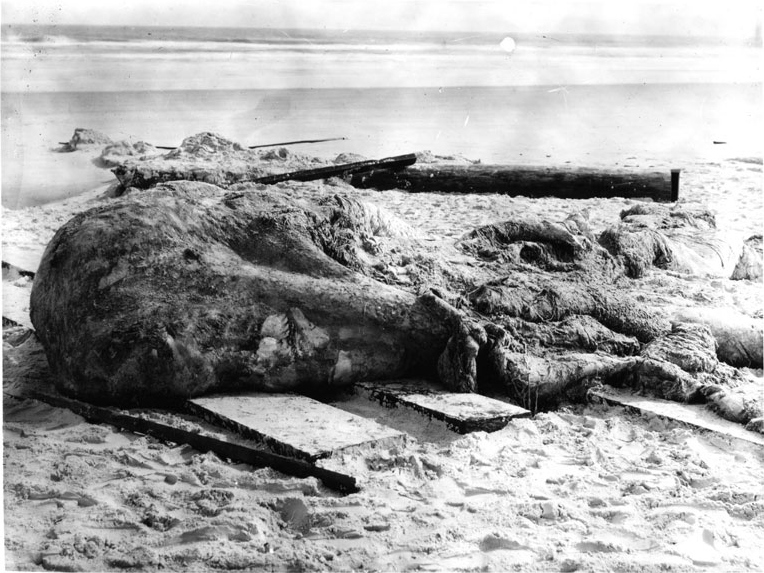
In late 1896, two boys found an enormous mass on Anastasia Island, south of St Augustine in Florida. It lay where the Atlantic had left it: pale, battered and stripped of the features by which an animal might ordinarily be recognised.
There was no complete creature to examine. There was, however, a great deal of it.
When the local physician De Witt Webb investigated, the folds and ragged projections suggested something extraordinary. Perhaps these were the remnants of arms. Perhaps the sea had delivered an octopus larger than any known to science.
Photographs went north to Yale. Pieces of the remains would follow. Between the arrival of the pictures and the arrival of the tissue, the animal changed. [1, 4]
A Monster by Post
Addison Emery Verrill was an experienced zoologist with a particular interest in marine invertebrates. From the descriptions and photographs, he initially accepted the possibility of an enormous octopus. The name Octopus giganteus entered the story.
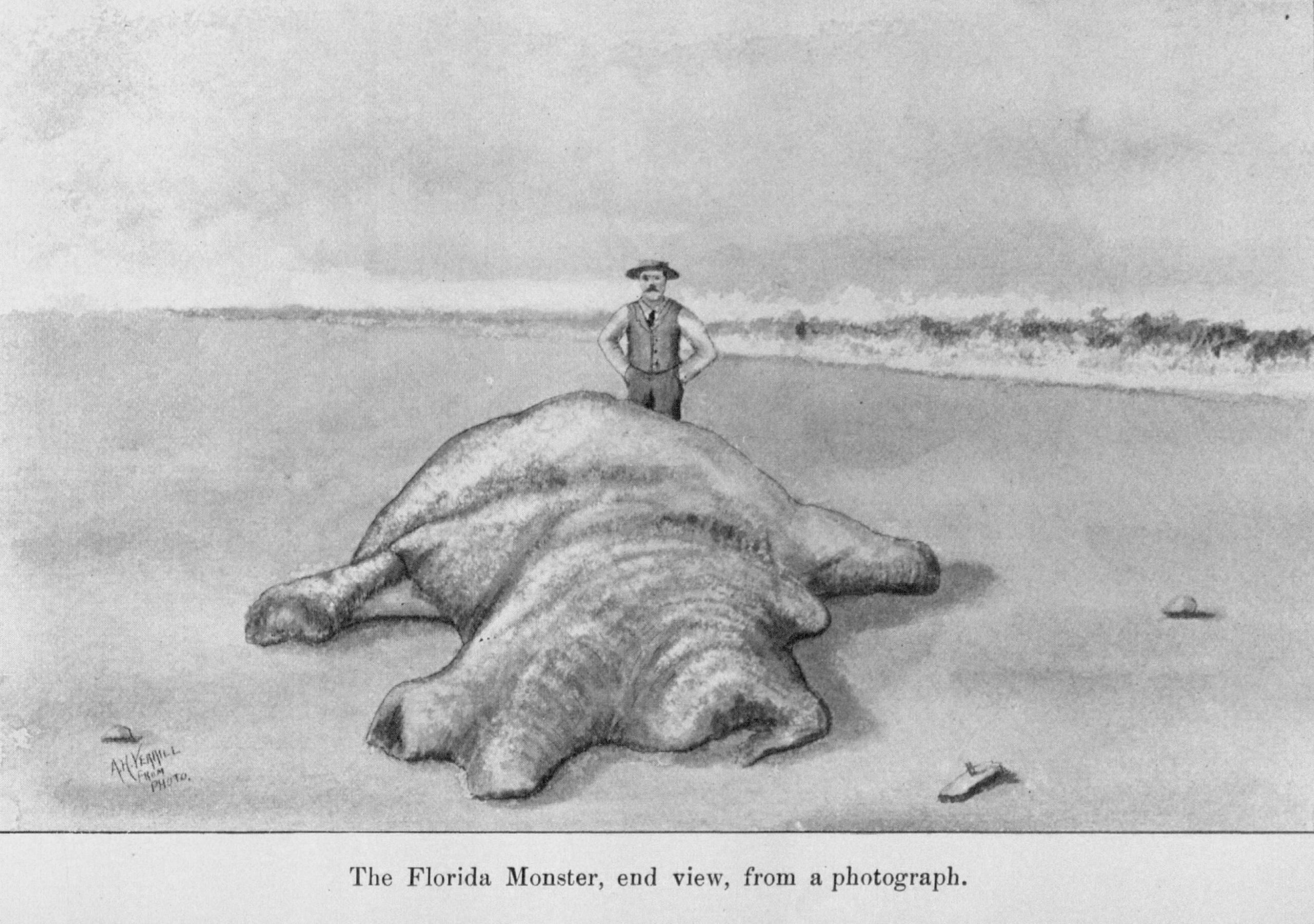
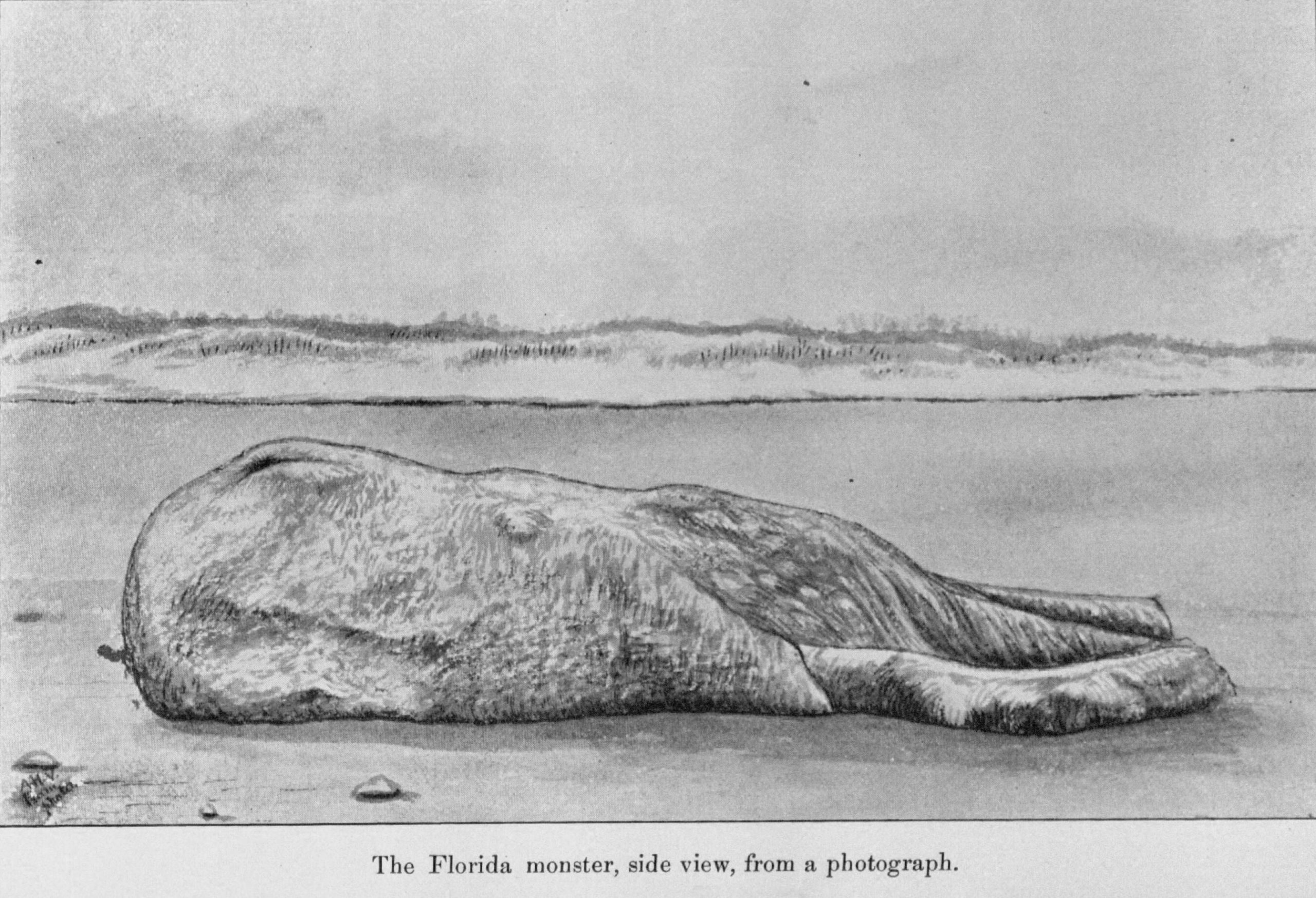
The dimensions were formidable. In his later published account, Verrill described a mass about 21 feet long, seven feet broad and four and a half feet high—roughly 6.4 by 2.1 by 1.4 metres. Its weight was estimated at seven tons.
These figures described the damaged material on the beach. They were not measurements of an intact animal.
Even so, the apparent arms offered a way to imagine what had been lost. One report described an appendage 36 feet long, still attached. If that were so, the shapeless body might be only the surviving centre of something immense.
But the appendage was less certain than the description made it sound. Verrill’s published footnote preserved another account, giving a length of about 23 feet and acknowledging that the supposed connection to the body had not been fully excavated.
Verrill subsequently rejected the earlier arm report as misleading. What looked in the photographs like the stumps of arms, he concluded, were folds in the thick covering.
The monster had acquired an outline before anyone had securely established its anatomy. [1]
What the Parcel Contained
The material sent to Verrill was thick, hard and elastic. It could be cut, with difficulty, using a razor. He described interwoven fibres and a smell resembling rancid whale oil.
It was not the muscular tissue he had expected from an octopus.
Verrill changed his identification. He now thought the mass probably came from the upper part of a sperm whale’s head. Yet he did not pretend that the fit was perfect. Its shape presented difficulties, and familiar structures were missing.
The correction appeared in the contemporary scientific record. It was not a verdict imposed on the story a century later.
On the beach, the practical difficulties continued. Moving and securing the remains took men, ropes and hauling equipment. Webb’s correspondence records the expense and frustration of trying to preserve something which was both scientifically interesting and exceptionally awkward to handle.
Whatever its identity, the discovery itself was real. [1, 4]
From the Original Record · 1897
The Identification Changes
Verrill’s short account preserves both the original octopus interpretation and his reasons for abandoning it. The two illustrations reproduced in this report accompanied that publication.
Read Verrill’s correction
“As soon as specimens of the tissues were sent to me, even a hasty examination was sufficient to show that this view was not correct, for instead of being composed of hardened muscular fibers, as had been supposed, the thick masses of tissue were found to consist almost wholly of a hard, elastic complex of connective tissue fibers of large size.”
A. E. Verrill, “The Florida Sea-Monster,” The American Naturalist, volume 31, number 364, April 1897, pp. 304–307. Public-domain text. “This view” refers to his earlier octopus identification.
The first link opens a readable transcription. The second opens the digitised volume containing the original pages. These are external reading links, not newly uploaded Archive files.
The Octopus That Would Not Disappear
A correction does not necessarily have the imaginative force of the claim it replaces.
The photographs remained striking. The estimates were enormous. And the suggestion of arms offered a creature people could picture, where decomposed connective tissue offered very little.
The octopus interpretation survived Verrill’s reversal and attracted renewed attention in later decades. By then, the beach had long since surrendered its evidence. What remained available for examination was material collected and preserved from the carcass.
That survival mattered. The argument could return to the tissue, rather than remaining entirely with the photographs.
Under the Microscope
In 1995, Sidney K. Pierce and colleagues examined preserved St Augustine material using electron microscopy and biochemical methods. They found it consisted almost entirely of collagen.
Its characteristics did not match the invertebrate collagen or arrangement of fibres expected in an octopus mantle. The Florida specimen instead pointed towards a large warm-blooded vertebrate. [2]
A further comparative study, published in 2004, examined several celebrated “sea-monster” remains alongside known whale tissue. The authors concluded that the mysterious masses were decomposed cetacean material.
As soft tissue and fat disappear, a tough framework of connective tissue can remain. Detached from the animal that gave it shape, it may look remarkably unlike a whale. [3]
Whose DNA?
The successful sperm-whale DNA identification in the 2004 study concerned the Chilean Blob. Another successful identification concerned the Nantucket remains, which matched a fin whale. Neither result was a direct DNA identification of the St Augustine specimen. The Florida conclusion rests on the tissue evidence and comparative analysis.
Evidence Assessment
| Evidence | What it supports |
|---|---|
| Photographs and contemporary accounts | A genuine discovery of enormous animal remains. They do not preserve the complete animal’s original anatomy. |
| Reports of arms | An influential part of the early octopus interpretation, but attachment was not securely established. Verrill rejected the most dramatic report. |
| Verrill’s tissue examination | A contemporary reason to abandon the octopus identification. His proposed sperm-whale head origin remained an anatomical interpretation. |
| The 1995 laboratory study | Collagen-rich material inconsistent with the proposed octopus anatomy and pointing towards a large warm-blooded vertebrate. |
| The 2004 comparison | Further support for decomposed whale material. It did not establish the Florida specimen’s species through DNA. |
Archive Assessment
The surviving tissue supports whale-derived remains, not a gigantic octopus. The exact animal and the original shape of the mass are less securely recoverable than that broader conclusion.
There is no need to invent the discovery’s strangeness. A huge object lay on a Florida beach. Experienced observers struggled to recognise it. Photographs suggested one animal; a parcel of tissue suggested another.
The error was understandable. Decomposition had removed the ordinary points of reference, while folds and frayed edges seemed to offer new ones. A body became a monster partly through what was missing.
The most revealing part of the story is how early the explanation began to change. Verrill did not hold to the octopus once the material reached him. The creature survived more successfully in the telling than it did under examination.
Archive Classification
Debunked
Applies to the claim that the St Augustine remains established a gigantic octopus. The discovery was genuine; examination of the surviving material supports decomposed whale remains. A direct DNA identification of the Florida specimen has not been established by the studies cited here.
Continue Through the Archive
At St Augustine, something remained to be photographed and sampled. At Gloucester, Massachusetts, the evidence took a different form: repeated sightings of an unfamiliar animal, without a verified specimen.
Explore the Gloucester Sea Serpent investigation →
Sources
- A. E. Verrill, “The Florida Sea-Monster,” The American Naturalist 31(364), April 1897, pp. 304–307. Contemporary description, correction of the octopus interpretation and accompanying illustrations. DOI: 10.1086/276596.
- S. K. Pierce, G. N. Smith, T. K. Maugel and E. Clark, “On the Giant Octopus (Octopus giganteus) and the Bermuda Blob: Homage to A. E. Verrill,” The Biological Bulletin 188(2), 1995, pp. 219–230. DOI: 10.2307/1542087.
- S. K. Pierce, S. E. Massey, N. E. Curtis, G. N. Smith Jr., C. Olavarría and T. K. Maugel, “Microscopic, Biochemical, and Molecular Characteristics of the Chilean Blob and a Comparison With the Remains of Other Sea Monsters: Nothing but Whales,” The Biological Bulletin 206(3), 2004, pp. 125–133. DOI: 10.2307/1543636.
- Mary Markey, “The Saint Augustine Monster,” Smithsonian Institution Archives, 18 August 2010. Historical overview, photographs and references to Webb’s correspondence. Its summary of the DNA evidence is qualified here against the 2004 paper.
Dating note: the Smithsonian overview places the discovery in November 1896; Verrill’s 1897 account gives 5 December. This report uses “late 1896” rather than presenting a disputed day as settled.
Further Reading
Webb’s correspondence: Smithsonian Institution Archives, Record Unit 189, Box 139, identified in the Smithsonian overview. The letters preserve the practical work behind the published accounts: collecting material, moving the remains and corresponding with distant specialists.
The original illustrated volume: The American Naturalist, volume 31, 1897. Verrill’s article appears on printed pages 304–307; the accompanying plates show the remains from the end and side.
Image and Document Credits
End-view illustration: Alpheus Hyatt Verrill (1871–1954), signed A. H. Verrill, from a photograph; published with Addison Emery Verrill’s 1897 article. Public domain. Scan via Wikimedia Commons. Resized for web presentation.

Side-view illustration: Alpheus Hyatt Verrill, from a photograph; same publication. Public domain. Scan via Wikimedia Commons. Resized for web presentation.

Historical photograph: Smithsonian Institution Archives, via Wikimedia Commons, “O giganteus15.jpg.” The Commons record identifies this reproduction as public domain in the United States; it does not establish a worldwide licence.

Document extract: A. E. Verrill, “The Florida Sea-Monster,” 1897. Public-domain historical text. The modern research papers are cited and linked; their full texts and figures are not reproduced here.