
A complete, concise Archive account of a case whose surviving record does not support a full investigation.
RAF Little Rissington, Gloucestershire, England · 21 October 1952
Complete and free to read
At first, Michael Swiney thought he was looking at parachutes.
His Meteor had climbed through cloud. Above it were three pale shapes, unfamiliar enough to interrupt a routine training flight.
In the other seat was Lieutenant David Crofts of the Royal Navy. Both men would remember the encounter more than half a century later: the light on the objects, the uncertainty, the decision to abandon the exercise.
Their recollections might have remained another story told long after the event. But in the RAF station’s record book, under the date 21 October 1952, a brief entry survives.
Three objects had been reported. Radar plots were said to support the sighting.
The entry does not tell us what they were.
Above the Cloud
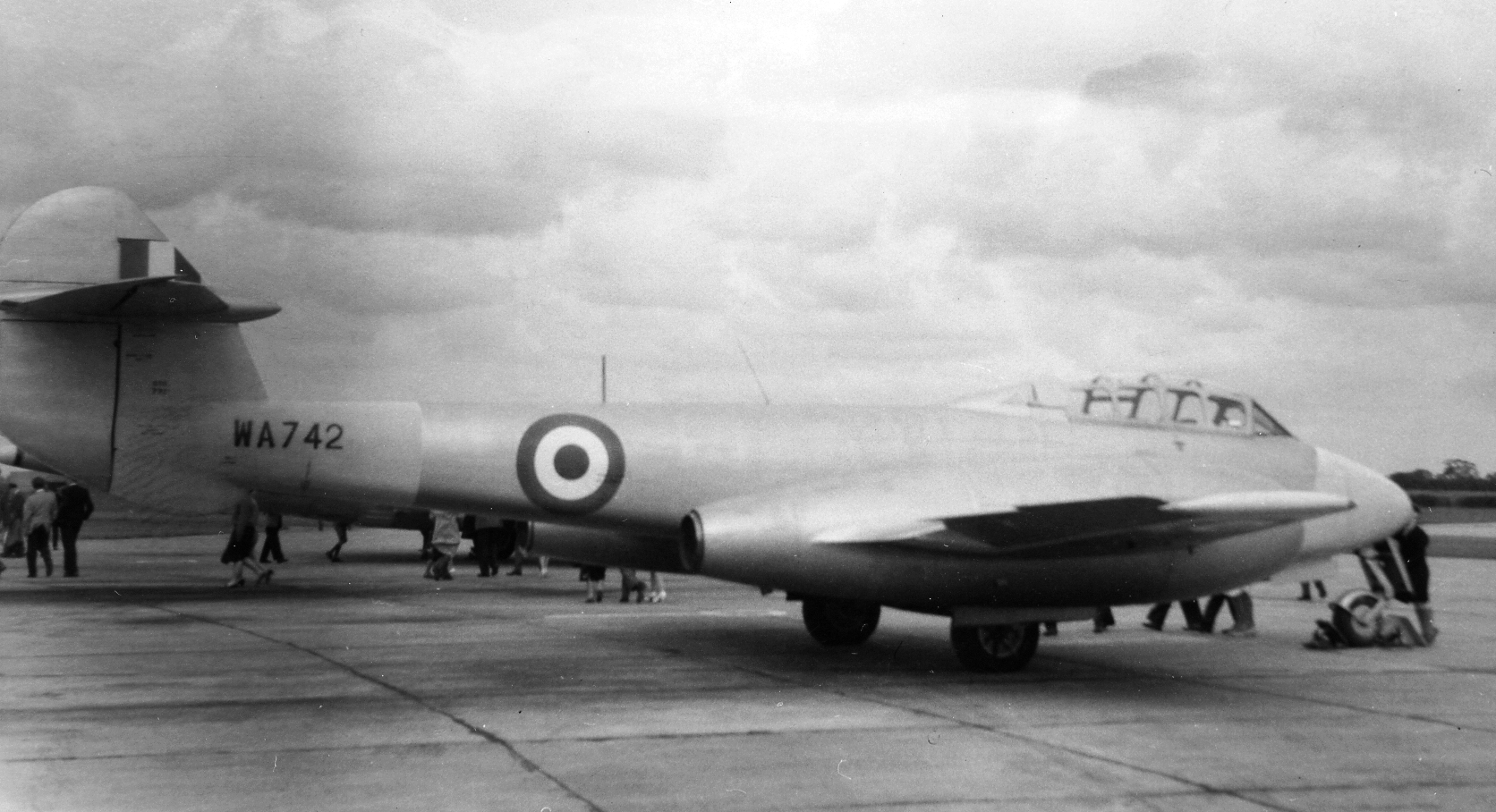
Flight Lieutenant Swiney was an instructor at the Central Flying School, based at RAF Little Rissington in Gloucestershire, England. Crofts was his student. Their aircraft was a Gloster Meteor T.7, a two-seat trainer from Britain’s first generation of jet aircraft.
In interviews conducted by researcher David Clarke in 2004, the men recalled emerging from cloud at approximately 12,000 feet and seeing the objects higher up.
Swiney remembered circular, plate-like forms. Crofts described a reflective appearance, comparing them to glass catching sunlight.
The parachute explanation did not satisfy them. The objects appeared to change position and then disappear. Swiney called off the exercise and reported what they had seen.
The detail belongs to those later interviews. The contemporary station entry is much shorter. [1, 2]
A Few Lines in the Record Book
The Operations Record Book describes three “saucer-shaped objects” travelling at high speed at about 35,000 feet during a high-level navigation exercise.
It adds that air-traffic control subsequently reported radar plots which appeared to confirm the crew’s account.
Then comes the official conclusion: the Air Ministry discounted an extraterrestrial explanation.
No alternative identification follows in the surviving entry.
The two altitude figures sometimes repeated in accounts of the case refer to different parts of the story. Approximately 12,000 feet is the height at which the men later remembered emerging from cloud. Approximately 35,000 feet appears in the station’s description of the objects. Neither supplies a recoverable measurement of their distance from the Meteor.
Swiney also referred to an entry in his own flying logbook, recording the sighting and the reported radar support. The station book is therefore best described as the surviving official summary, rather than the only record of any kind associated with the encounter. [1, 2]
The Evidential Divide
The official summary: a report of three unusual objects, high apparent speed and radar plots said to support the sighting.
The later recollections: the objects’ appearance, the witnesses’ reactions, a reported fighter scramble and interviews by an Air Ministry team.
The original statements and radar material would help connect those accounts. They have not been located in the sources examined for this report.
The Questions Afterwards
Swiney and Crofts remembered being questioned after the flight. Statements were taken and drawings requested.
They also recalled learning that fighters had been sent to investigate, without making contact. Those aircraft were not something the two men had watched intercepting the objects themselves; this was information they remembered receiving afterwards.
That distinction leaves two overlapping histories: what happened in the Meteor’s cockpit, and what the crew were told had happened elsewhere.
The surviving station entry mentions supporting radar plots. It does not preserve the plots, identify the equipment or describe an interception in sufficient detail to reconstruct it.
When Swiney later sought his original report, he was told that many early UFO records had been routinely destroyed. Clarke’s published account places the missing papers within that history of disposal. It does not establish the individual fate of every document connected with this flight. [2]
What the Radar Cannot Now Tell Us
Radar is central to the case because it appears to offer a second way of observing the same event.
But the surviving evidence is a written reference to radar support, rather than a set of returns available for inspection.
Without timings, bearings and the original plots, it is not possible to demonstrate how closely the radar information matched what the airmen saw. The description may reflect a genuine correlation. It may also compress a more uncertain exchange between crew and ground control.
The phrase in the record book remains significant. Its underlying evidence is missing.
Possible Explanations
Parachutes were Swiney’s first interpretation. Balloons offer another possible explanation for pale objects seen at height. Neither can be tested adequately without a flight path, weather information tied to the observation and a reliable estimate of distance.
The reported high speed is a difficulty for those suggestions. Yet the surviving summary does not show how it was calculated, or whether it came from the visual observation, the radar information, or both.
Reflections and atmospheric effects could complicate the appearance of objects above cloud. An unfamiliar or poorly seen aircraft is another possibility. There is no recovered identification linking any of these explanations to the three forms reported that afternoon.
Nor does the absence of an identification establish an extraordinary origin. The Air Ministry rejected an extraterrestrial interpretation, but the reasoning behind that conclusion is not supplied by the station entry.
The difficulty is not a shortage of possible answers. It is the absence of the observations needed to choose between them.
Evidence Assessment
| Record | What it supports |
|---|---|
| Station Operations Record Book | That an unusual sighting was officially recorded in 1952, with radar plots reported as supporting it. |
| Swiney’s personal logbook entry | A further record associated with the flight, discussed in the published research. It does not replace the missing investigation papers. |
| Witness interviews in 2004 | Detailed recollections of the encounter and its aftermath, recorded more than fifty years later. |
| Reported radar support | A potentially important corroboration, but without the original plots needed to examine the correspondence. |
| Air Ministry conclusion | An extraterrestrial explanation was discounted. The surviving summary does not provide an identification or the reasoning behind that decision. |
Archive Assessment
Little Rissington has a firmer historical basis than a sighting known only through a late interview. The station record establishes that a report was made and entered into the RAF’s account of its activities.
The uncertainty lies in what that report can now establish about the objects themselves.
The witnesses’ later descriptions give the encounter its texture: three pale forms above cloud, the first thought of parachutes, the interruption of a training flight. The official summary gives it a date and a place in the record. Neither preserves enough information for a reliable identification.
The men returned to their airfield. The entry was written. Somewhere between the few lines that remain and the papers that have not been found lies the explanation they were seeking.
Archive Classification
Evidentially Limited
An officially recorded aerial sighting with reported radar support. The surviving summary and later testimony establish the history of the report, but do not identify the objects or allow the claimed radar correlation to be independently reconstructed.
Key Facts
- Date: 21 October 1952.
- Location: A flight from RAF Little Rissington, Gloucestershire, England.
- Witnesses: Flight Lieutenant Michael Swiney, RAF, and Lieutenant David Crofts, Royal Navy.
- Aircraft: Gloster Meteor T.7 jet trainer.
- Reported objects: Three pale, circular or saucer-shaped forms.
- Official record: The station Operations Record Book, cited as AIR 29/2310.
- Principal limitation: Original witness statements and radar plots have not been located in the sources examined.
Read the Published Research
The National Archives Book Extract
The National Archives provides an extract from David Clarke’s The UFO Files. It includes his account of the interviews and a reproduction of the Little Rissington Operations Record Book entry.
The case appears on printed pages 48–51. The reproduced station record is on printed page 50, which is page 13 of the PDF.
Read the National Archives Extract · PDF
This link opens the publisher’s copy. The modern publication and its reproduced illustrations carry copyright notices; the PDF is not reproduced or offered here as a freely reusable document.
Continue Through the Archive
For another encounter involving military witnesses and questions about what the surviving evidence can establish, continue with The Nimitz Tic Tac Encounter.
Or follow the history of an image whose original negatives remain missing in The Calvine Photograph.
Sources
- RAF Little Rissington, Operations Record Book, entry for 21 October 1952. The National Archives, AIR 29/2310. Reproduced in the publication below.
- David Clarke, The UFO Files: The Inside Story of Real-Life Sightings. The National Archives, 2009, pp. 48–51. Includes the author’s 2004 interviews with Michael Swiney and David Crofts. Publisher’s extract.
Further Reading
David Clarke, The UFO Files: The Inside Story of Real-Life Sightings — the wider history of official British investigations and the records they left behind. Find on Amazon UK.
The National Archives, UFO research guide — guidance to the surviving collections and their catalogue references. Read the research guide.
Image Credit
“Meteor T7”: photograph by TSRL, showing Gloster Meteor T.7 WA742 in 1961, probably at Farnborough. Source: Wikimedia Commons. Licensed under Creative Commons Attribution–ShareAlike 3.0 Unported. Displayed at reduced size. The photograph is contextual and does not depict the encounter or its aircraft.
Editorial note: the report distinguishes the station’s contemporary summary from later witness recollections. References to missing documents describe the material unavailable in the sources examined; they do not establish deliberate suppression or the destruction of every associated record.