
A complete, concise Archive account. Free to read in full.
Kersey, Suffolk · October 1957
The bells stopped as the boys approached the village.
At least, that is how William Laing remembered it years later. He and two other young naval trainees were crossing the Suffolk countryside on a map-reading exercise. Their instructions were simple: find the village, observe it and report back.
The village was Kersey.
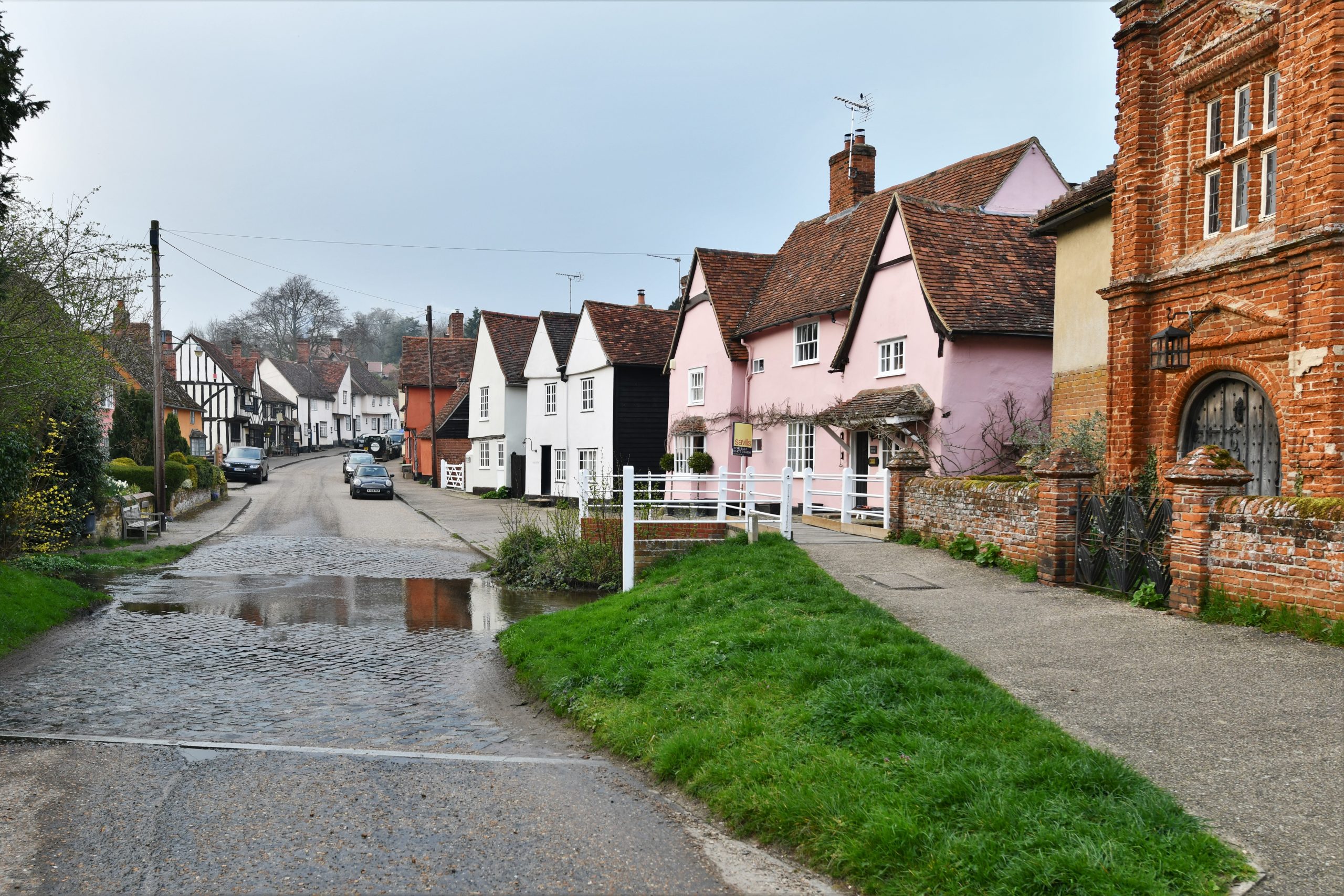
The three came down towards a street of old houses and a shallow stream that crossed the road. They saw no one. The buildings looked ancient, their windows dirty. There were no obvious aerials or wires, no cars in the street, and no smoke rising from the chimneys.
Even the ducks beside the water seemed still.
At one building, the boys looked through a window. Inside, Laing later said, were two or three skinned animal carcasses. Parts of them appeared green with age. There was no one tending them, and he recalled no counter or furniture in the room.
They looked into another building. It seemed empty too.
By the time they left, the village had become an uncomfortable place to be. They hurried back up the hill. Then, according to Laing’s later account, the bells could be heard again and smoke was rising from chimneys.
They had found Kersey. What they had seen there was another matter. [1]
Three Boys, Three Memories
The boys were Laing, Michael Crowley and Ray Baker. All three were young Royal Navy trainees, unfamiliar with this part of Suffolk. Laing later recalled telling their superiors about the odd village. The officers, he said, were sceptical, but agreed that the boys had reached Kersey.
For years, the incident remained with Laing. By the late 1980s, he and Crowley were both living in Australia. They spoke by telephone and discussed what they remembered of that day.
Crowley recalled less than Laing, but he also remembered the silence and the apparent absence of modern features. He remembered the strange shop too. Their conversation encouraged Laing to write to Andrew MacKenzie, a writer and member of the Society for Psychical Research. [1]
MacKenzie investigated. He corresponded with Laing, gathered further recollections and looked into Kersey’s history with local help. In 1990, Laing returned to England and walked through the village with him.
The third member of the group was traced as well. Baker, however, remembered nothing of the unusual experience. [1–2]
That does not mean the others imagined what they described. It does mean that the later investigation had two recollections to examine, not three independent accounts of the same events. Laing and Crowley had also discussed the incident before approaching MacKenzie.
MacKenzie published the case in his 1997 book Adventures in Time: Encounters with the Past. By then, four decades had passed since the morning in Kersey. [1–3]

The Shop by the Water
The building with the carcasses became one of the most persuasive details in MacKenzie’s investigation.
According to historian Mike Dash’s account of the case, the building Laing identified was a private residence in 1957. MacKenzie found that it had once been a butcher’s shop, recorded as such by 1790.
For MacKenzie, the apparent match mattered. The boys were strangers to the village. If they had described a butcher’s premises in a building no longer used for that purpose, how had they known? [1]
There is a gap between the match and the conclusion. A record of a butcher’s shop in 1790 would not establish what the building contained in the fifteenth century. Nor does it independently show what the boys saw through the window in 1957.
The original trade record and Laing’s correspondence have not been examined for this report. The building’s earlier use is included here as reported in Dash’s discussion of MacKenzie’s investigation.
Still, the carcasses remain the detail that is hardest to set aside. A quiet street is easy to picture. An empty room can be misunderstood. Two or three animal carcasses, apparently ageing behind the glass, are a more particular thing to remember.
A Village Made to Look Old
Kersey’s houses really are old. The village has a substantial collection of medieval buildings, and its street still follows a much older layout. The decline of the local cloth trade helped preserve buildings that might otherwise have been replaced or refaced. [4–5]
That gives us one reason why the boys might have felt they had entered another age. There is also a more specific explanation for the missing wires.
Dash traced reports about the arrival of electricity in Kersey in the early 1950s. Preservation concerns had been raised about the effect of overhead lines on the village. He cites a parliamentary publication reporting that lines were routed behind houses, with a cable laid underground where the street had to be crossed. [1]
From the main street, some modern equipment may therefore have been less conspicuous than the boys expected. That does not account for every feature they later described. It does make the absence of visible wires a less reliable sign that they were seeing an earlier century.
Dash’s cited parliamentary page has not been independently examined for this report.
See Kersey Around 1957
A British Railways poster by Jack Merriott shows Kersey’s street, ford and church at approximately the time of the reported visit.
View the poster in the Science Museum Group collection →
The poster is an artist’s view prepared for a railway advertisement. It gives an impression of the village, rather than a photographic record of the boys’ experience.
The Church on the Hill
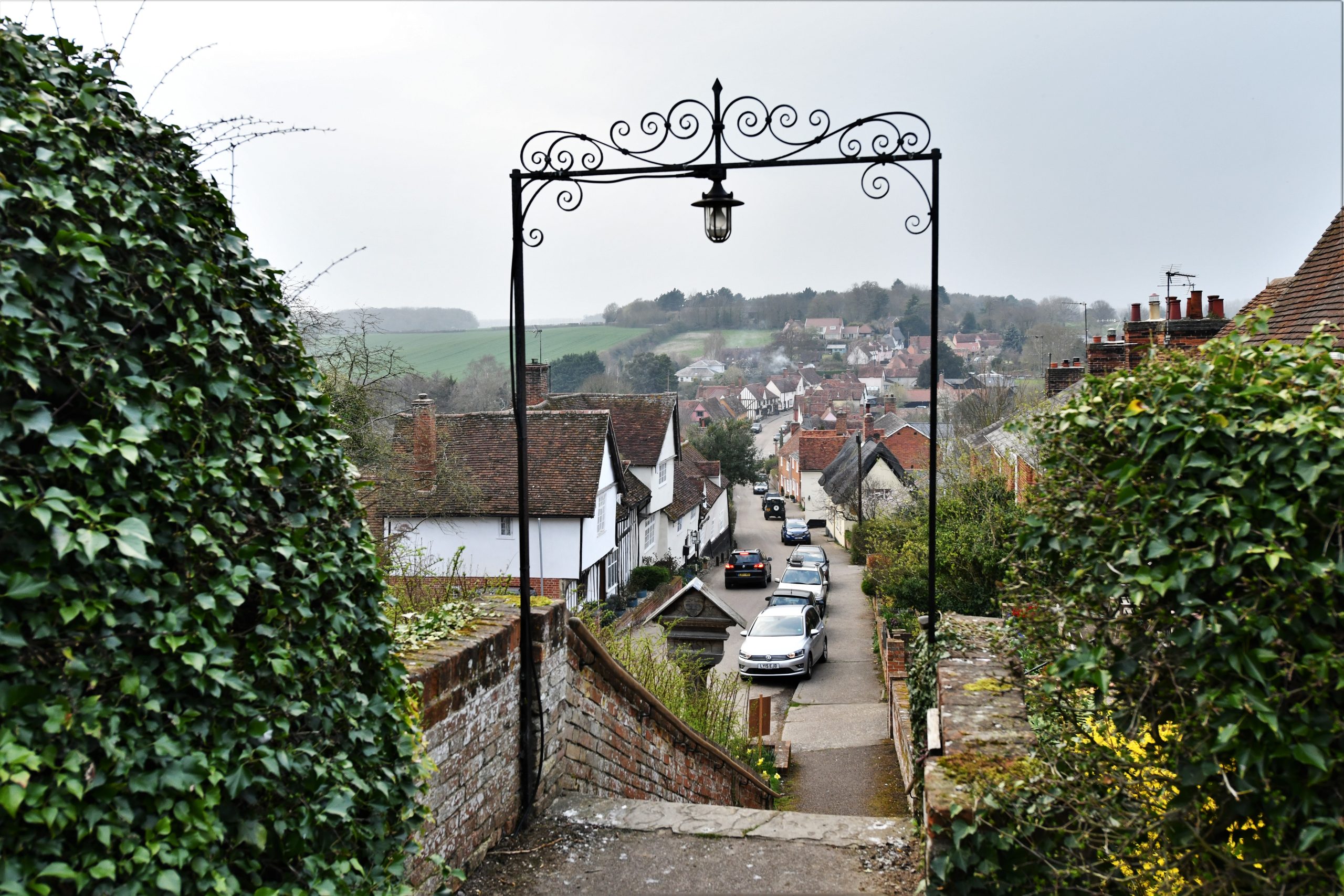
St Mary’s stands above Kersey, its tower a prominent feature of the village. The boys reportedly saw the church as they approached. Laing later said that, once they were in the village, he could no longer see it.
MacKenzie considered whether that absence might help date the scene. Work on the tower began in the medieval period and was not completed until 1481. He suggested that the boys might have seen the village around 1420, before the finished tower rose above it. [1,6]
It is an intriguing proposal, but it depends on an absence. A building unnoticed from one position is not necessarily a building that was not there. Houses, trees and the slope of the street can affect what a person sees.
The church itself is older than the completed tower. Kersey had a church long before 1481; an unfinished tower would not have meant an empty hill. [6–7]
What Happened in Kersey?
MacKenzie considered the case an example of possible retrocognition: an apparent perception of a place as it existed in the past. The old buildings, the missing church tower and the former butcher’s shop seemed to him to point in that direction.
A different reading begins with the Kersey the boys could have encountered in 1957: a village of genuinely old houses, quiet on a Sunday morning, with some electrical lines kept away from the main street. An unfamiliar place can feel older than it is, especially when there is little movement to anchor it in the present.
Memory adds another layer. Laing and Crowley discussed the incident before MacKenzie gathered their accounts, decades after the visit. Details can be reinforced or altered through retelling, even when the people recalling them are sincere.
None of that identifies what was inside the room. The boys may have misunderstood what they saw. The later memory may have changed. Or there may have been a scene for which the available records offer no answer.
The evidence does not establish that they entered the past. It also leaves us with a specific question that is not answered by the village’s old appearance: what lay behind that window?
Archive Classification
Unresolved
Two former naval trainees later recalled an unusual visit to Kersey. The village’s historic buildings and the routing of some electrical cables offer context for parts of their account. The reported shop remains difficult to assess, while the long gap before investigation limits what can be established about the original experience.
Key Facts
- Reported date: October 1957; exact day unconfirmed.
- Location: Kersey, Suffolk, England.
- People involved: Three young Royal Navy trainees on a map-reading exercise.
- Central claim: The village appeared silent, deserted and older than expected.
- Investigation: Andrew MacKenzie gathered accounts decades later; Laing revisited Kersey with him in 1990.
- Central question: What did the boys see through the window?
Continue Through the Archive
Explore more accounts in which familiar places have become the setting for unfamiliar experiences.
Sources
- Mike Dash — “Three 1950s youths in a medieval plague village”, 24 July 2011. Detailed examination of MacKenzie’s account and the village’s historical context.
- Anthony Campbell — review of Adventures in Time. Includes a summary of MacKenzie’s investigation and the third witness’s lack of recollection.
- Society for Psychical Research, Psi Encyclopedia — “Andrew MacKenzie”. Biographical account, including his 1990 visit to Kersey with William Laing.
- Kersey Parish Council — Local History. Background on the village’s medieval buildings and development.
- Babergh District Council — Kersey Conservation Area Appraisal. Background on the village’s historic buildings and layout.
- Historic England — Church of St Mary, Kersey. Listed-building record and description of the church and tower.
- Kersey Parish Council — History of St Mary’s Church. Local account of the church’s earlier fabric and later reconstruction.
Further Reading
Andrew MacKenzie, Adventures in Time: Encounters with the Past, Athlone Press, 1997. The original book-length investigation of the Kersey case.
Science Museum Group: “Suffolk — Kersey”. A British Railways poster of the village, dated approximately 1957.
Image Credits
Header: Kersey Village and Ford, Michael Garlick, 2019, CC BY-SA 2.0. Resized for the website.
Churchyard view: Kersey village from St. Mary’s Churchyard, Michael Garlick, 2019, CC BY-SA 2.0. Resized for the website.
Editorial note: MacKenzie’s complete book, the original witness correspondence, the cited parliamentary page and the historical butcher’s-shop record were not independently examined for this report. Details from the investigation are attributed to the accessible accounts listed above.