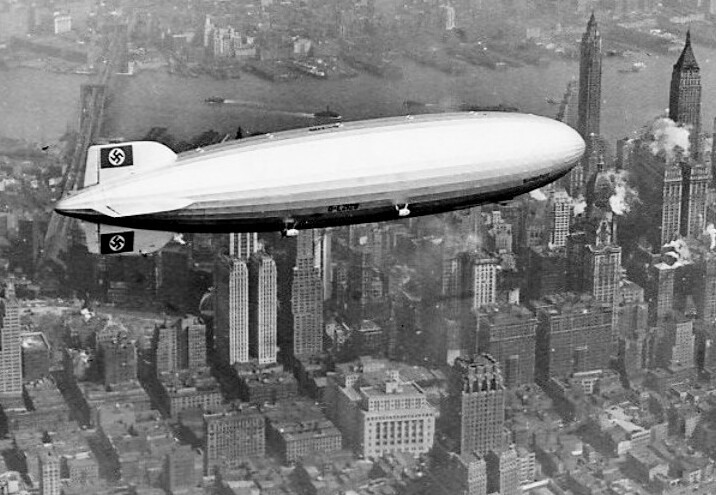

LZ 129 Hindenburg · Passenger lounge, 1936–1937
Reconstruction: Friedrichshafen, Germany · Complete and free to read
Before the fire, there was a room with armchairs, low tables and a world painted across the wall.
Ships crossed its oceans. Lines swept between continents. Above the passengers’ heads, the history of distant journeys accompanied the journey they were making themselves.
Decades later, photographs of that room began circulating online. Some viewers stopped looking at the ships and studied the land instead.
Was that an inland sea in North America? Had water occupied the heart of Africa? Why did parts of South America seem to belong to another map?
The questions grew into a more extraordinary suggestion: perhaps the painting preserved the shape of a world that had disappeared.
The room itself was gone. Its likeness survived in photographs and, eventually, a museum reconstruction. Between those records and the modern claims lies a quieter puzzle: what, exactly, are we looking at?
The Seas That Shouldn’t Be There
Online discussions in February and March 2023 show the mural acquiring a new audience. In Reddit’s r/oldmaps community, readers debated apparent inland waters. In r/Retconned, the unfamiliar interior prompted questions about memory as well as geography.
Some saw flooded continents. Others saw vegetation or decorative markings. The disagreement began before any theory of a lost world: the viewers did not agree about what the shapes represented. [1]
From there, the image entered the language of a historical “reset”—the suggestion that a vanished civilisation or an earlier arrangement of the Earth had been concealed from later generations.
The mural offered an inviting surface for that idea. It looked old. Its original setting had been destroyed. Small details were difficult to inspect.
Yet the painting also contained familiar coastlines, recognisable vessels and journeys with names.
A World Made for Passengers
The map occupied the lounge on the starboard side of A Deck. Across the airship lay the dining room; nearby was a writing room. This was passenger accommodation, separate from the spaces where the crew navigated.
The mural’s artist was Otto Arpke. The Zeppelin Museum describes wall coverings of balloon silk and paintings produced using an elaborate spraying technique. The furniture, designed by Fritz August Breuhaus de Groot, combined an elegant appearance with lightweight aluminium construction. [2, 3]
Arpke’s map gathered together the voyages of Columbus, Vasco da Gama, Magellan and Captain Cook. It also showed modern German liners and airships: the Bremen and Europa, LZ 126 and Graf Zeppelin.
Centuries of travel occupied the same wall.
For someone crossing the Atlantic aboard Hindenburg, the arrangement had an immediate meaning. The old sailing routes led towards the age of the ocean liner, then towards the airship carrying them.
The mural was telling a history of movement. Its painted world was the stage on which that history unfolded. [2]
The Room Before the Fire
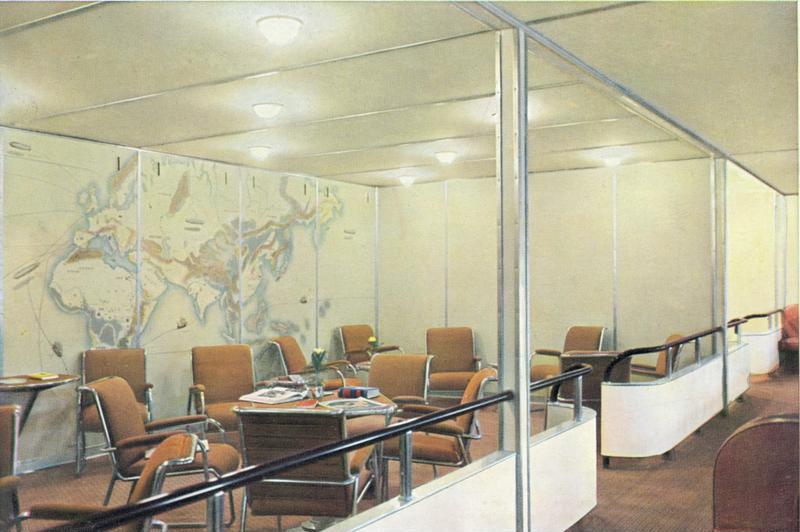

The Bundesarchiv photograph records the lounge before its destruction. Beyond the tables, the mural stretches across the wall. Africa, Europe and Asia are visible, with ships and airships passing between them.
It establishes that the map belonged to the original interior. It is less helpful with the smaller marks. The surviving digital copy is modest in size, and the wall is photographed at an angle.
Its colour also needs care. The archive record identifies the scene and its approximate date, but the material examined does not establish how this colour reproduction was produced. It cannot serve as an exact reference for Arpke’s original palette. [4]
On 6 May 1937, the airship burned while coming in to land at Lakehurst, New Jersey, United States.
The room could no longer be entered. Its reconstruction would have to begin with what the records preserved.
A Room Built Twice
At the Zeppelin Museum in Friedrichshafen, on Lake Constance in southern Germany, visitors can step into a full-size reconstruction of part of the passenger accommodation.
The museum describes it as built according to historical plans. Its present harbour-station building opened in July 1996. The reconstructed rooms belong to that later history, even when a photograph makes them appear almost untouched by time. [5]
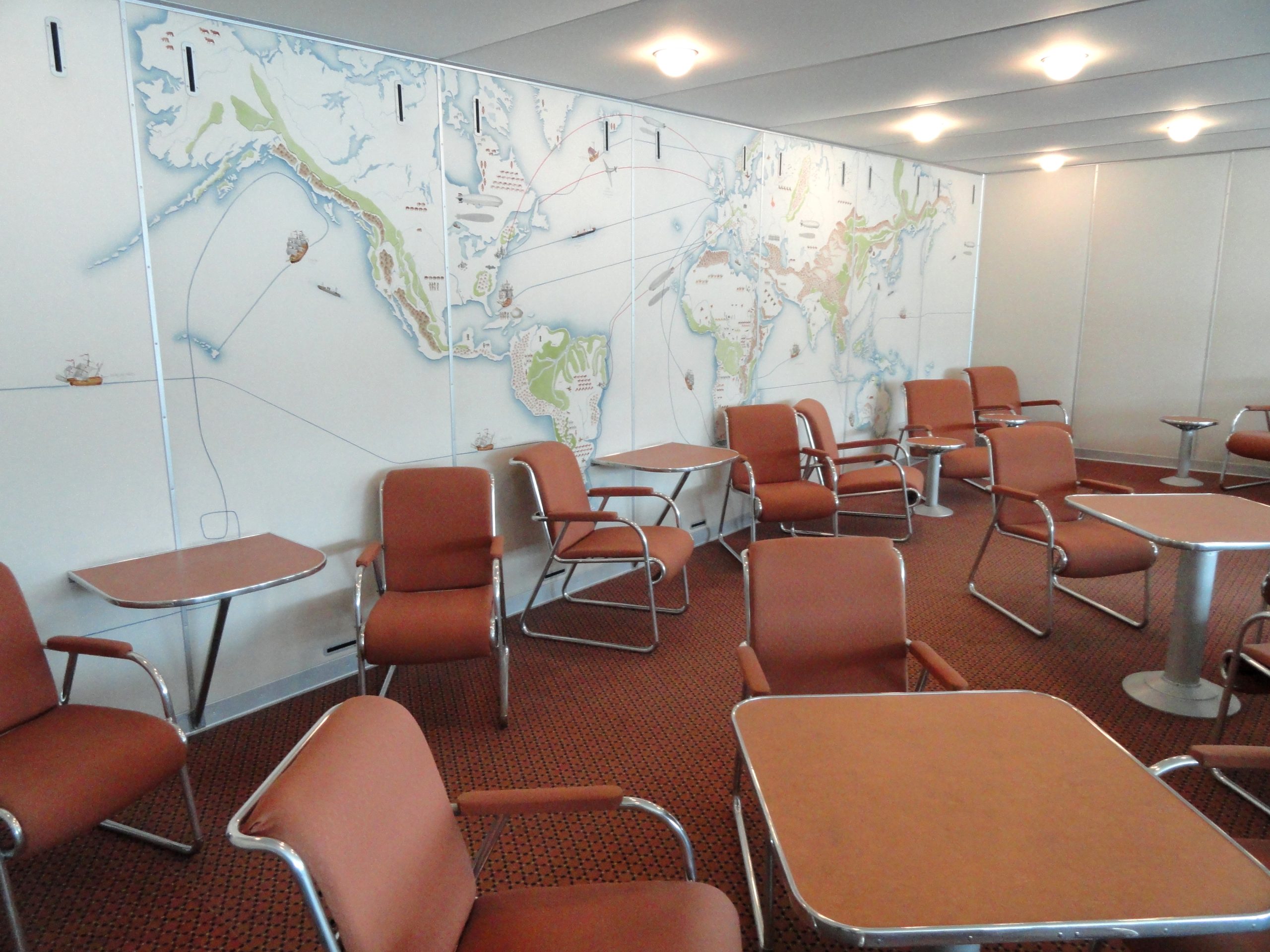

The modern photograph brings the wall much closer. It also gives us something more useful than a general impression of strangeness.
The seas and recognisable lakes are shaded blue. Broad areas within the continents are green. Brown markings suggest relief; small figures and symbols occupy other parts of the land.
In this view, the green areas do not share the colour used for the surrounding oceans. Reading all of them as water overlooks a distinction plainly present in the reconstruction.
That is an observation about the photograph, rather than a recovered explanation from the artist. Vegetation or other land shading is a plausible reading. Without a contemporary key, the exact meaning of every patch remains uncertain.
The uncertainty is narrower than the lost-world claim suggests. We can be unsure what a marking means without having evidence that it records a vanished sea.
The World the Wall Was Selling
The museum offers another reading of the map: a story about national prestige.
Its exhibition guide places the mural within the politics of Nazi Germany. Earlier voyages of exploration lead towards modern German transport achievements. The airship appears at the culmination of that sequence.
The painted world invited admiration for a particular country’s technology. In the museum’s interpretation, exploration and conquest formed the background to a claim of German superiority. [6, pp. 7–8]
The same guide records that one mural was omitted when the interior was reconstructed because it depicted people in a racist manner. The passage does not identify that omitted image as the world map.
It does establish that recreating the passenger accommodation involved choices about what to reproduce. The room we can enter today is a historical reconstruction, not an untouched fragment of the airship. [6, p. 8]
This is a different kind of hidden history from the one proposed online. It concerns the selection of voyages, the representation of other cultures and the future passengers were being invited to admire.
The Other Hindenburg Map
A separate map survived the final voyage.
Passenger Ferdinand Lammot “Peter” Belin marked the airship’s progress on his own copy, following route information posted in the lounge. The Smithsonian National Postal Museum describes its survival among his recovered possessions. [7]
Belin’s map recorded a particular crossing. Arpke’s mural brought together journeys from different centuries.
Both can appear in a search for “the Hindenburg map”. They are different objects, with different purposes and different histories of survival.
The smaller map offers a trace of one passenger watching his journey unfold. It does not explain the disputed markings on the lounge wall.
Examine the Record
The Photograph, the Reconstruction and the Museum Guide
The two lounge images above can be enlarged within this page. The historical photograph records the original setting; the modern view allows closer inspection of the reconstructed painting.
The museum’s exhibition guide adds its interpretation of the mural’s political setting. The relevant passage is on printed pages 7–8.
Read the Museum Guide · German PDF
English reading note
The guide treats the map and the surrounding murals as a selective account of world history: international exploration leads towards modern German achievements, with the Zeppelin presented as the culmination. It also notes that one mural containing racist representations was not recreated.
This is an English summary, not a complete translation. The guide does not identify that omitted mural as the map or provide a key to the disputed land markings.
What further evidence could answer
An annotated design, a contemporary description of the colour scheme or detailed records of the mural’s reconstruction could clarify individual markings.
The Zeppelin Museum maintains an archive and specialist library. No document explaining every disputed patch was located in the publicly accessible material examined for this report. That does not establish that no such record survives.
The museum guide is linked for reading. It is not reproduced here or presented as licensed for commercial republication.
Evidence Assessment
| Surviving record | What it establishes |
|---|---|
| Historical lounge photograph | The world-map mural was present in the original passenger interior. Small details and the provenance of the supplied colours remain difficult to assess. |
| Documented ships and routes | A decorative account of exploration and transport, bringing historical voyages together with modern German vessels and airships. |
| Museum reconstruction | A later recreation based on historical records. It allows inspection of the reconstructed design but is not the original painted surface. |
| Visible colour differences | The reconstruction distinguishes blue water from broad green areas on land. This weakens an indiscriminate reading of the green areas as inland seas. |
| Museum interpretation | Historical context for the mural’s political message. It does not decode every artistic detail. |
| Online lost-world claims | Evidence of modern interpretation and speculation. No identified source map or artist’s explanation connects the mural to a suppressed geography. |
Archive Assessment
The mural is genuine. The claim that it records a different physical Earth remains unsupported.
Its purpose is more securely documented than the meaning of every small detail. The ships and routes tell a story of exploration and technological progress. The museum’s research places that story within the national ambitions of its time.
The enlarged reconstruction also offers a practical reason for caution: areas described as submerged land do not all use the painting’s colour for water. The apparent seas are partly a problem of interpretation.
There is still room for further research into Arpke’s design and its reconstruction. Those questions concern the making and meaning of a particular painting. They do not yet lead to an erased civilisation or a vanished arrangement of continents.
For the original passengers, the map accompanied a crossing into the future of travel. For some later viewers, it has become a glimpse of a missing past.
Between those two readings stands the same painted world—and a room that had to be built twice.
Archive Classification
Unsupported
The classification applies to claims of hidden seas, a historical reset or an alternative physical geography. The original mural is documented; those interpretations are not established. Some artistic details remain open to more specific archival research.
Key Facts
- Object: World-map mural in the passenger lounge of LZ 129 Hindenburg.
- Artist: Otto Arpke.
- Original setting: Starboard side of A Deck, 1936–1937.
- Subject: Exploration and transport routes, including ships and airships.
- Loss of the original: The airship burned at Lakehurst, New Jersey, United States, on 6 May 1937.
- Reconstruction: Zeppelin Museum, Friedrichshafen, Germany.
- Modern claim: That unfamiliar markings reveal a lost or suppressed geography.
Continue Through the Archive
Another doubtful geography survived in a rather different setting: an island repeatedly carried forward onto maps, until a research vessel went looking for it.
Read Sandy Island: The Land That Stayed on the Map →
Sources
- Reddit discussions: “1936 World Map from the Passenger Lounge of the Hindenburg,” r/oldmaps, 3 March 2023; and “Hindenburg interior from 1930s: unusual world map,” r/Retconned, 20 February 2023. Records of modern discussion, not authorities on historical geography.
- Airships.net, “The Hindenburg’s Interior: Passenger Decks”. Specialist documentation of the lounge’s location and the explorers, liners and airships represented in the mural.
- Zeppelin Museum Friedrichshafen, “Salon of the LZ 129 Hindenburg,” Google Arts & Culture. Description of the furniture, wall coverings and Otto Arpke’s painting technique.
- Bundesarchiv, Bild 147-0639. Historical lounge image, dated circa 1936–1937; photographer unknown.
- Zeppelin Museum Friedrichshafen: “Technology tour” and “History of the Zeppelin Museum”. Reconstruction and institutional history.
- Zeppelin Museum Friedrichshafen, Gefühlte Wahrheiten: Zeppeline und Nationalsozialismus, guide in accessible German, printed pages 7–8. Discussion of the wall paintings as political imagery and the omission of one mural during reconstruction.
- Smithsonian National Postal Museum, Fire & Ice: Hindenburg and Titanic, 2012, travel-route section; and “Ferdinand Lammot ‘Peter’ Belin, Jr.”. Documentation of Belin’s separate route map and recovered possessions.
Further Reading
Dan Grossman, Cheryl Ganz and Patrick Russell, Zeppelin Hindenburg: An Illustrated History of LZ-129. The History Press. A photographic history of the airship, its accommodation and service.
Zeppelin Museum, Perceived Truths: Zeppelins and National Socialism. The museum’s exhibition overview provides wider context for the relationship between airship imagery, technological prestige and political power.
Image Credits
Hindenburg above Manhattan: Associated Press, 6 May 1937. Wikimedia Commons source record, which lists the photograph as public domain in the United States on publication-without-notice grounds. Cropped version; displayed at reduced size. This is a jurisdiction-specific public-domain statement, not a worldwide Creative Commons licence.
Original lounge: Bundesarchiv, Bild 147-0639 / CC BY-SA 3.0 DE. Photographer unknown, circa 1936–1937. The supplied crop is shared under the same licence. Colour-process provenance has not been established in the material examined.
Reconstructed lounge: Daderot, 29 April 2011, via Wikimedia Commons. Photograph released under the CC0 1.0 Universal Public Domain Dedication. Displayed at reduced size.
Editorial note: observations about blue and green areas refer to the reproduced museum photograph. They are not presented as an authenticated colour key from Otto Arpke. The German museum guide is summarised in original English wording rather than reproduced in full. Research reviewed October 2026.