A complete, concise Archive account of a case whose surviving record does not support a full investigation.
Near Wallaceburg, Upper Canada · Traditionally dated to November 1829
Three women were working in a barn on John T. McDonald’s farm when a heavy pole dropped from the rafters and struck the floor among them. They moved it aside. A second fell, then a third. No one could see who—or what—had released them.
It was the beginning of a story in which lead balls entered a house without a gun, fires appeared in watched rooms and a frontier family found itself under siege. Before the mystery ended, it would acquire a clairvoyant, a silver bullet and a black-headed goose. But the ending most often retold is not necessarily the oldest meaning of what happened at Baldoon.
The First Disturbances
The McDonalds lived close to the Chenail Ecarté, now known as the Snye, in the former Baldoon settlement near present-day Wallaceburg, Ontario. Established by Lord Selkirk in 1804 for Scottish families, the settlement suffered from flooding and disease before its property was sold in 1818. The McDonald farm remained in a landscape that was settled but still isolated.
According to the family account, lead balls then appeared to pass through windows, leaving holes in the glass but dropping with little force inside. Stones and other objects moved without a visible thrower. Visitors came to watch, and some later signed statements describing what they believed they had seen.
The disturbances broadened. Household objects were overturned and animals reportedly injured or frightened. Most dangerous were fires discovered in cupboards, on floors and in outbuildings. Watchers could extinguish one only to hear that another had started elsewhere. The house and barn were ultimately lost.
A Record Written After the Event
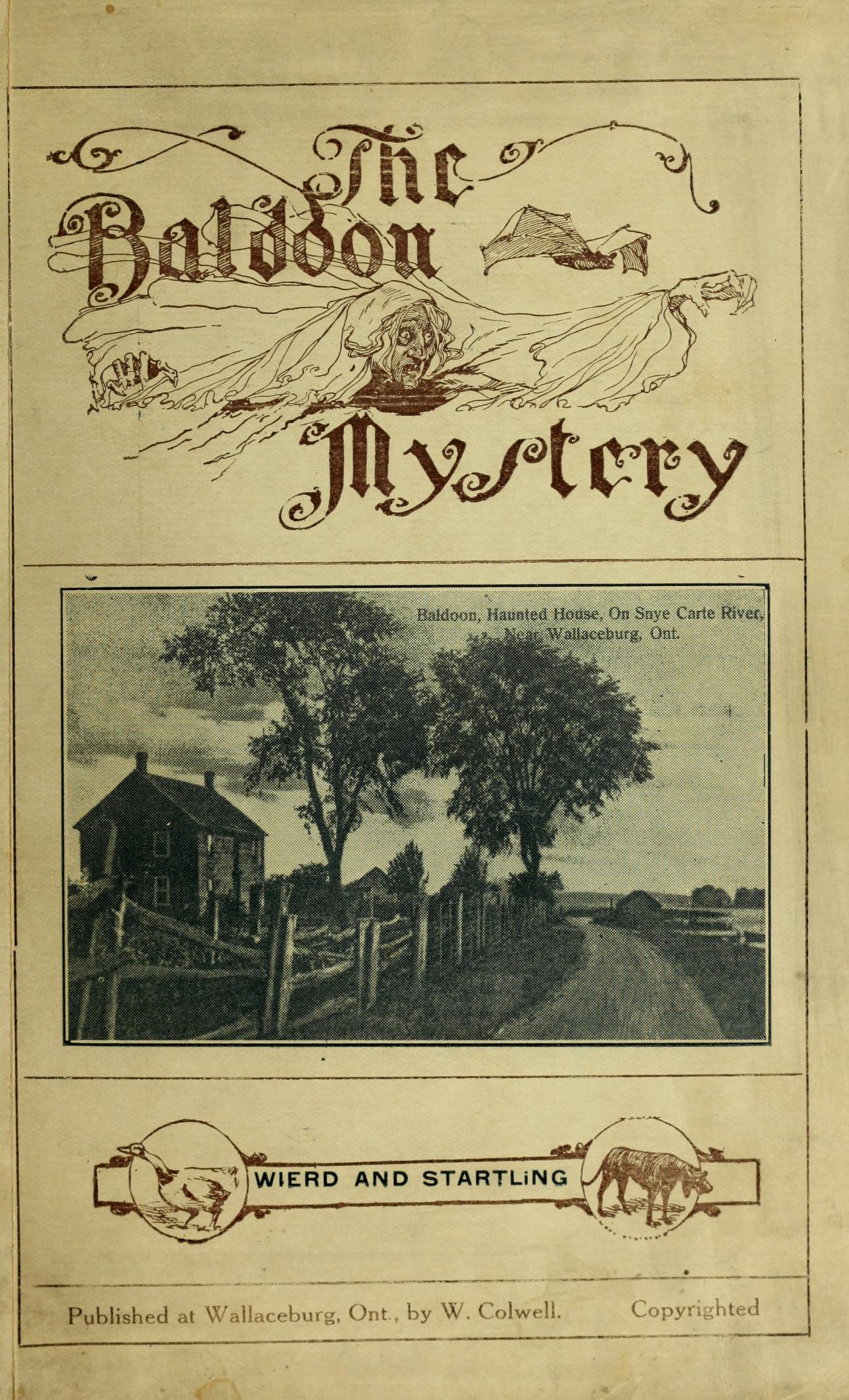
The Baldoon Mystery is unusually detailed for an early Canadian haunting, but detail is not the same as contemporaneous evidence. The best-known narrative was written by Neil T. McDonald, a son of John T. McDonald, and published long after the reported events. Its 1910 edition describes itself as a fourth edition and presents a sequence supported by named testimonials.
Those statements connect the tradition to real people, but they are retrospective. Decades separated the alleged disturbances from the surviving publication, allowing memory and folklore to shape the account. Even its dating varies: the preface places events between 1830 and 1840, while a witness statement gives November 1829 as their beginning.
THE EVIDENTIAL DIVIDE
Preserved in the tradition: named witnesses, falling beams, inexplicable projectiles, repeated fires and a family driven from its home. Missing from the surviving record: contemporary police or legal files, physical objects with a secure history, fire-investigation records and an account written while the events were taking place. The later testimony may preserve genuine experience, but it cannot show how much the story changed before it reached print.
The Black Goose
As ordinary remedies failed, the published story turns towards folklore. John McDonald consulted a young woman reputed to possess second sight. She asked whether an unfamiliar goose had joined his flock. When he recalled a grey bird with a black head, she told him that the source of the persecution was concealed within it and that ordinary lead would not harm it.
McDonald made a silver bullet and fired at the goose. The bird was wounded in the wing. Soon afterwards, according to the narrative, an elderly neighbour believed to have quarrelled with the family was seen with an injured arm. The disturbances then ceased. In the version that came to dominate local memory, the woman and the bird were connected, and the Baldoon Mystery became a witch story.
It is a memorable ending, but also the portion most recognisably shaped like a folktale. The suspected woman, special projectile and matching wounds are motifs found far beyond Baldoon. They do not prove that the affair was invented, but warn that its ending may have been polished through repetition.
A Different Memory of the Land
An earlier published account gives the disturbances a different meaning. Methodist minister Peter Jones recorded an Ojibwe explanation in his 1861 history. In that version, small spirit beings—identified as Mamagwasewug—had occupied a poplar grove until a settler cut and burned it. The ensuing stones, noises and fires were retaliation for the destruction of their place.
This account should not be treated as independent proof of supernatural activity. It is important because it shows that Baldoon was never only a European witch legend. The same disturbances could be understood as a story about violated land, displacement and the consequences of settlement. Later retellings usually foregrounded the silver bullet and pushed this older interpretation to the margins.
What May Explain It?
Harassment or deception could account for projectiles, noises and some fires. A family quarrel features in the later narrative, and someone familiar with the property might have created disturbances without being caught. No perpetrator can now be demonstrated.
Accident and misinterpretation may explain individual episodes. A log building heated by open fires was vulnerable to sparks; poles could fall; frightened witnesses might connect unrelated mishaps. The apparently organised sequence is precisely what cannot be checked against contemporary records.
Memory and folklore offer the strongest explanation for the story’s finished form. Accidents, malicious acts or unexplained events may have formed its core. Repeated telling could then have joined and heightened them without requiring dishonest witnesses.
Archive Assessment
Baldoon is more substantial than a placeless campfire story. It belongs to a known family, a real settlement and a published tradition that preserves the names of people who claimed direct knowledge. Its competing interpretations also reveal how one mystery can carry very different histories.
What it cannot provide is a secure route back to the first incidents. The record was assembled too late to separate observation from recollection, and neither the witch narrative nor the spirit-of-place interpretation can be tested as an explanation.
The Archive classifies the Baldoon Mystery as a historically important but evidentially limited haunting tradition: a case with named witnesses and an unusually durable local record, transformed too thoroughly in the telling to establish what caused the original disturbances.
KEY FACTS
- Traditional date: November 1829; some later editions give a broader 1830s period
- Location: Former Baldoon settlement near Wallaceburg, Upper Canada
- Household: John T. McDonald and his family
- Reported activity: Falling beams, projectiles, moving objects, animal disturbances and unexplained fires
- Principal surviving account: Neil T. McDonald’s later family narrative and collected testimonials
- Famous ending: A black-headed goose wounded with a silver bullet
- Status: Cause unresolved; surviving evidence is retrospective
Continue Through the Archive
For a full investigation into a haunting shaped by testimony, publicity and later retelling, continue with 112 Ocean Avenue: The Amityville Case in the Paranormal Encounters collection.
Sources
- McDonald, Neil T. Baldoon Mystery: Weird and Startling. Wallaceburg: W. Colwell, 1910 edition.
- Jones, Peter. History of the Ojebway Indians. London: A. W. Bennett, 1861.
- Wallaceburg and District Museum, “Baldoon Mystery.”
- Ontario Heritage Trust, “The Baldoon Settlement, 1804–1818.”
- Fehr, Rick. “Baldoon Mystery.” Psi Encyclopedia, 2020.
Further Reading
- Campey, Lucille H. — The Silver Chief: Lord Selkirk and the Scottish Pioneers of Belfast, Baldoon and Red River. Find on Amazon UK.
- Fowke, Edith — Canadian Folklore. Find on Amazon UK.
Image credit: Cover of Neil T. McDonald’s The Baldoon Mystery, Wallaceburg, 1910. Public domain; digitised from the Queen’s University Library copy by the Internet Archive.