Key Facts
- Name: Occultus, a supposedly mechanical human figure.
- Presenter: Otto Widmann in German coverage; “Mr. Whitman” in the American magazine account.
- Advertised abilities: Walking, speaking, singing and responding to commands.
- Surviving record: A photograph, press descriptions and an advertisement.
- Central question: What happened behind the human face?
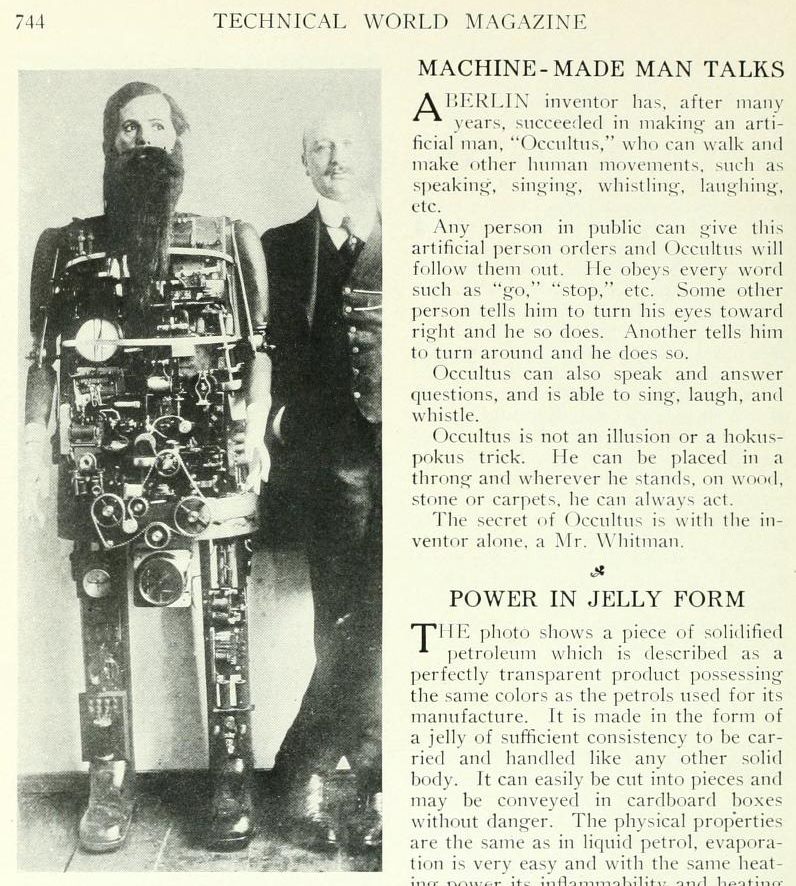
The photograph offers its own explanation. The clothing has been opened. Where a chest should be, there is machinery.
Above it is a bearded face.
In 1911, readers were told that this figure could walk among them, turn its eyes when asked and answer their questions. It could sing, whistle and laugh. At a little distance, one newspaper claimed, it could scarcely be distinguished from a living person.
Beside it stands the man credited with its creation.
The figure was called Occultus. Its chest had been exposed for the camera, but its secret remained with its presenter. [1, 3]
A Voice in the Machinery
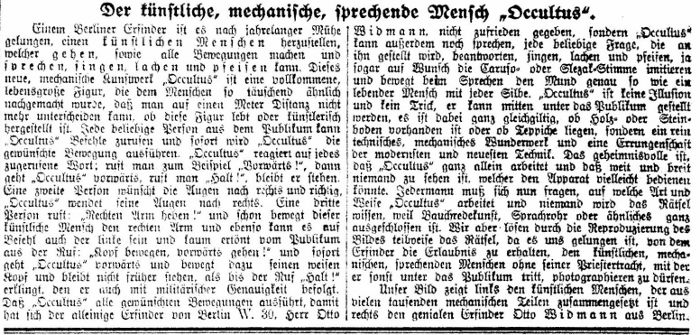
The account in Vienna’s Die Neue Zeitung reads almost like a demonstration.
Someone calls “Forward!” and Occultus advances. Another calls “Stop!” and it halts. Its eyes turn left and right. An arm rises. The mouth moves with each syllable.
Then the performance becomes more ambitious. Occultus can answer any question, the paper says. On request, it can imitate the singers Caruso or Slezak.
The article insists that this is neither illusion nor trickery. Wooden floors, stone floors and carpets make no difference. Nobody can be seen operating the figure.
Finally, the reader is offered a privileged view: the inventor has allowed it to be photographed without its usual chest covering. The exposed mechanism is supposed to bring the mystery a little closer to resolution.
There is no corresponding account of anyone tracing the workings, testing the voice or choosing the conditions of the demonstration. The picture reveals a chest full of parts. The remarkable performance remains in the words around it. [1]
Historical Document · 27 March 1911
The Speaking Mechanical Man
Read the complete English translation
The Artificial, Mechanical, Speaking Man “Occultus”
Translated from the supplied German clipping. The claims below belong to the original article.
After years of effort, a Berlin inventor has succeeded in producing an artificial person who can walk, perform all kinds of movements, and speak, sing, laugh and whistle.
This new mechanical marvel, “Occultus”, is a complete, life-sized figure, so deceptively modelled on a human being that, from a distance of one metre, it is impossible to distinguish whether the figure is alive or artificial.
Anyone in the audience can call out commands, and “Occultus” will immediately perform the requested movement. “Occultus” responds to every word addressed to it. If, for example, someone calls “Forward!”, “Occultus” moves forward; if someone calls “Stop!”, it remains still.
A second person wishes its eyes to move left and right. “Occultus” turns its eyes left and right. A third person calls, “Raise your right arm!”, and the artificial person raises its right arm; the left arm can likewise be raised on command.
A call from the audience—“Move your head, forward, walk!”—immediately makes “Occultus” move forward while moving its head. It does not stop until “Stop!” is called, which it obeys with military precision.
The sole inventor, Mr Otto Widmann of Berlin W. 30, has not been satisfied merely to make “Occultus” perform all these movements. “Occultus” can also speak, answer any question put to it, sing, laugh and whistle. On request, it can even imitate the voices of Caruso or Slezak, opening its mouth with every syllable exactly as a living person would.
“Occultus” is no illusion and no trick. It can be placed right among the audience. It makes no difference whether the floor is wood or stone, or whether carpets are laid: it is a purely technical, mechanical marvel and an achievement of the most advanced and newest technology.
The mysterious thing is that “Occultus” works entirely on its own, with nobody visible anywhere who might be operating the apparatus. Everyone must wonder how “Occultus” works, yet nobody will solve the mystery, since ventriloquism, a speaking tube or anything similar is entirely ruled out.
By reproducing the photograph, however, we partly solve the mystery: we have obtained the inventor’s permission to photograph the artificial, mechanical, speaking person without the chest covering it usually wears when appearing before the public.
Our picture shows, on the left, the artificial person assembled from many thousands of mechanical parts, and on the right its ingenious inventor, Otto Widmann of Berlin.
Translation notes: Caruso and Slezak are Enrico Caruso and Leo Slezak. “Berlin W. 30” is a historical postal district. The article’s final paragraph refers to the photograph accompanying the original newspaper text.
The Same Assurance, Across the Atlantic
By August, Technical World Magazine was carrying the photograph and a short account headed “Machine-Made Man Talks”. The presenter was now “Mr. Whitman”.
The claims are familiar: movement, speech, questions answered, commands obeyed. So is the insistence that Occultus can perform on wood, stone or carpets.
The resemblance to the Austrian account is close. Both offer the same reassuring details and leave the same decisive question unanswered. This looks more like a claim travelling between publications than a second, independently documented examination.
The American item ends with the secret still in the inventor’s keeping. [1, 3]
From the English-Language Record
“The secret of Occultus is with the inventor alone, a Mr. Whitman.”
Closing sentence of “Machine-Made Man Talks”, Technical World Magazine, August 1911, p. 744.
The Man Beside the Figure
Modern research by the Heinz Nixdorf MuseumsForum connects the German Otto Widmann with the Whitman of English-language coverage. The name Adolph Whitman appears in later reporting.
The museum also found Widmann associated with an illusion-apparatus business. That connection places the figure within the world of manufactured wonders, although it does not identify a particular trick.
The often-repeated date of 1909 is less secure. The museum traced a London entertainment called Occultus in The Scotsman of 5 October that year, but could not establish whether it was Widmann’s later figure.
The photograph can safely be described as published in 1911. Its date of exposure, and the precise beginning of the attraction, remain uncertain. [5]
Sixty Heller to See a Talking Head
In Salzburg, Austria, an advertisement offered something rather more specific.
“Occultus”—in enormous lettering. Below it: “The Talking Head!”
The notice promised a mysterious wonder, celebrated appearances across Europe and modern technology at its highest perfection. Admission was sixty heller, with a reduced price for children, military personnel and students. The attraction would be there for only a few days.
The walking figure of the newspaper account has narrowed to a talking head. Perhaps this was a different presentation of the same apparatus. Perhaps the name covered more than one attraction. Perhaps the newspaper’s repertoire had always been larger than the performance.
The advertisement does not decide between them. It does, however, bring Occultus out of the language of invention and into the ordinary business of selling tickets. [2]
Historical Document · 8 October 1911
The Occultus Advertisement

Read the complete English translation
The Mysterious Wonder of the World!
Occultus
The Talking Head!
The highlight of the Brussels World Exhibition!
Modern technology brought to its highest perfection!
The Berliner Tageblatt writes:
“Occultus”, a sensational attraction, is currently being shown at the Passage-Panoptikum. One truly stands before a mystery: “Occultus” disproves the saying of the Jewish sage, “Everything has been seen before.”
“Occultus”, received with the greatest success in Paris, London, Vienna, Brussels, St Petersburg, Moscow, Budapest and elsewhere, was visited in Berlin by 18,464 people.
“Occultus” can be seen for only a few days!
Open from 10 a.m. until 11 p.m.
Admission: 60 heller.
Children, military personnel and students: 30 heller.
Translation notes: “Panoptikum” here refers to an exhibition of curiosities or waxworks. Heller were units of Austrian currency. The reference to a “Jewish sage” is retained from the original. The claimed visitor total, exhibition appearances and quotation attributed to the Berliner Tageblatt have not been independently verified.
An Army of Mechanical Men
The story did not remain a modest entertainment.
A transcription of an article attributed to the Fort Wayne Sentinel, Indiana, dated 20 June 1914, gives the inventor ambitions far beyond the exhibition room. Mechanical men could be manufactured in their hundreds. They could fight wars, crew ships and work without exhaustion.
The imagined future moves between conquest and comfort. An invulnerable army might subdue the world; alternatively, tireless servants might release humanity from dangerous and disagreeable work.
These are extraordinary promises to attach to a figure whose operating method was still undisclosed. They reveal how quickly a supposed invention could become a story about the future.
The original newspaper page was not independently inspected for this report. The passage survives here as a documented transcription of later press publicity, not as a verified statement of Widmann’s intentions or achievements. [4]
Who Was Doing the Listening?
A moving arm and an answer to an unexpected question are different problems.
A recording could give a figure a voice. Motors could provide movement. Neither, on its own, would explain how it selected an appropriate answer to a stranger.
Someone concealed from the audience could make that selection. An operator could also respond to commands while the figure appeared to obey them. That possibility does not require the visible machinery to be entirely false: a mechanical performance can still depend on a person.
The MuseumsForum suggests remote control, possibly through a concealed cable. It is a plausible reconstruction, not a mechanism recovered from Occultus itself. [5]
The contemporary claim that nobody could be seen operating the figure leaves room for precisely that distinction. An unseen operator is still an operator.
Evidence Assessment
| Surviving evidence | Assessment |
|---|---|
| The historical photograph | Records a bearded figure with an exposed mechanical-looking chest beside its presenter. It cannot demonstrate movement, speech or independent operation. |
| The March and August 1911 reports | Describe an extensive repertoire. Their closely similar claims should not be counted as two independent technical examinations. |
| The Salzburg advertisement | Documents the marketing of an attraction called Occultus as a talking head. Its itinerary and attendance figures remain publicity claims. |
| The 1909 reference | Identified by museum research, but continuity with the figure pictured in 1911 has not been established. |
| The 1914 mechanical-army story | Evidence of the expanding publicity, consulted through a later transcription rather than the original newspaper page. |
| The operating method | No independent technical examination establishing the full advertised performance was located. Concealed human control remains a plausible explanation. |
Archive Assessment
Occultus was not invented by a modern internet caption. A figure was photographed, articles were published and an attraction bearing the name was advertised.
What those records do not establish is a machine capable of everything promised for it. The surviving descriptions are confident precisely where the technical evidence is thin. Even the opened chest tells us less than its theatrical presentation suggests.
It would be equally premature to announce a particular deception as solved. A concealed operator, a recording and a limited mechanism offer ordinary possibilities, but no recovered arrangement allows the performance to be reconstructed with confidence.
The question is therefore narrower than whether a human-like robot existed before its time. How much could this particular figure do, and where did the machinery end and the showman’s assistance begin?
In the photograph, the covering has been removed. We have been invited to look inside.
The answer is still out of sight.
Archive Classification
Evidentially Limited
Contemporary sources document Occultus as a photographed figure and advertised attraction. They do not establish its full claimed abilities or disclose a complete operating method. Mechanical entertainment with concealed human assistance is plausible; a specific explanation remains unproven.
Continue Through the Archive
A surviving image can preserve the appearance of a mystery while leaving its explanation outside the frame.
Explore more cases in The Anomalous Archive →
Sources
- Die Neue Zeitung, Vienna, 27 March 1911, p. 4. “Der künstliche, mechanische, sprechende Mensch ‘Occultus’.” Historical text clipping reproduced above with an English translation. Digitised by ANNO / Austrian National Library.
- Salzburger Volksblatt, 8 October 1911, p. 15. Advertisement for Occultus, “Der sprechende Kopf!” Historical clipping reproduced above with an English translation. Digitised by ANNO / Austrian National Library.
- Technical World Magazine, August 1911, printed p. 744. “Machine-Made Man Talks.” Digitised volume contributed by Gerstein Library, University of Toronto, to Internet Archive. The magazine text was checked against the digitised transcription.
- Fort Wayne Sentinel, Indiana, 20 June 1914, p. 13, as identified and transcribed by Cybernetic Zoo. Consulted through that transcription; the original newspaper page was not independently inspected.
- Heinz Nixdorf MuseumsForum, “Auf den Spuren von Occultus”, 18 February 2022. Museum research concerning Widmann’s identity, the possible 1909 appearance and proposed operating methods.
Further Reading
- Heinz Nixdorf MuseumsForum, “Auf den Spuren von Occultus”. Includes links to historical newspaper records and a patent associated with Otto Widmann. The patent is contextual evidence, not a surviving blueprint of Occultus.
- Technical World Magazine, printed page 744. The digitised page places the Occultus item within its original magazine setting.
- Cybernetic Zoo, “1909 — Occultus / Barbarossa — Whitman (German)”. A collection of press transcriptions and visual references; dates and identifications require comparison with the original sources.
Image and Translation Credits
Header clipping: Technical World Magazine, August 1911, p. 744; photograph uncredited. Digitised volume contributed by Gerstein Library, University of Toronto, to Internet Archive. The catalogue records its possible copyright status as “NOT_IN_COPYRIGHT”, with its copyright assessment identified as United States-based. Clipping displayed at reduced size.
German newspaper article: Die Neue Zeitung, 27 March 1911, p. 4. ANNO / Austrian National Library. Historical clipping located through the Heinz Nixdorf MuseumsForum.
Advertisement: Salzburger Volksblatt, 8 October 1911, p. 15. ANNO / Austrian National Library. Historical clipping located through the Heinz Nixdorf MuseumsForum.
Reproduction note: the Austrian National Library’s published use policy permits subsequent use of its web reproductions while reserving any underlying third-party rights. This credit does not claim that every item on the library’s website has the same rights status.
English translations: prepared for The Anomalous Archive from the supplied German clippings. Historical claims and quotations are retained as part of the documents; they are not presented as independently verified performance results.