KEY FACTS
- Location: Karyamukti, Cianjur Regency, West Java, Indonesia.
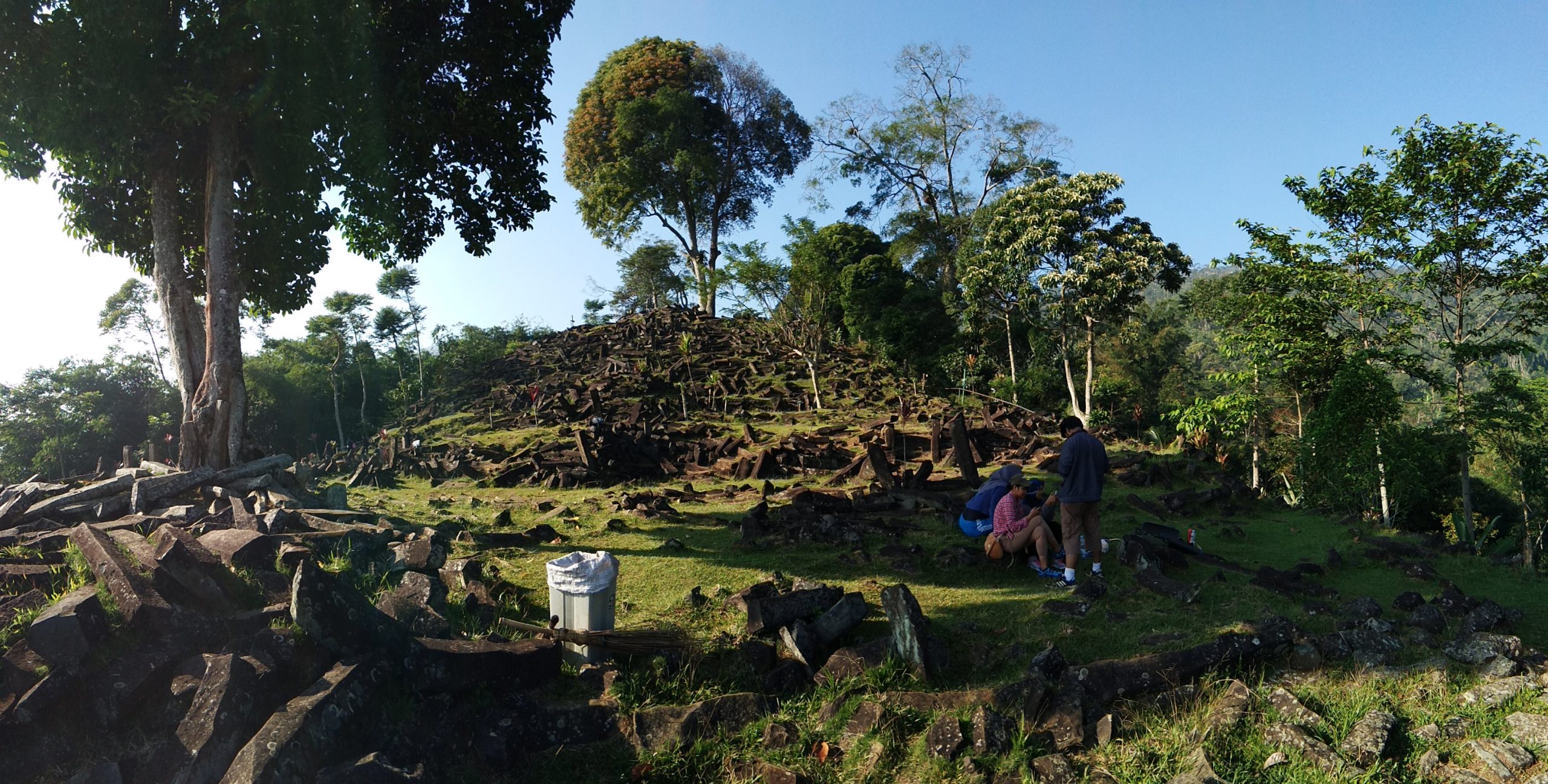
- Visible monument: Five ascending stone terraces arranged across a volcanic hilltop.
- Material: Naturally formed columns of basaltic-andesite, selected and arranged by human builders.
- Recorded history: Described in colonial-era records and brought back to official attention in 1979.
- Modern investigation: Excavation, core drilling and several geophysical survey methods.
- Central question: Do constructed layers extend deep inside the hill?
- Classification: Ancient Mysteries.
- Status: Monument confirmed; deeper interpretation disputed.
The Mountain That Changed Beneath Their Feet
At first, Gunung Padang looks like a mystery of scale rather than existence. Climb the long stone stair through the trees and the summit opens into a run of terraces — upright stones, low alignments, retaining walls covering the ground. Whatever this place was originally for, someone shaped it on purpose.
For generations, that was the whole story: an important Indonesian megalithic monument, built on top of a natural hill. Then a team of researchers started looking underneath the terraces. Radar, electrical current and seismic energy went into the ground. Core drills passed through soil and rock. Different surveys seemed to pick up layers, changes in material, unusual pockets of space deep beneath the summit.
What followed transformed how people saw the site. The visible terraces, the researchers proposed, might only be the most recent surface of something much larger. Beneath them, perhaps, lay earlier building phases, hidden chambers, and evidence of monumental construction from a period when conventional archaeology has no comparable civilisation anywhere in the region.
In 2023, that argument made it into a peer-reviewed archaeological journal, complete with diagrams, survey profiles and radiocarbon dates reaching far beyond anything accepted about monumental architecture’s timeline. For a brief window, one of archaeology’s most extraordinary claims had apparently secured a foothold in the scientific record.
But a date can be perfectly accurate while the story wrapped around it is wrong. An underground anomaly can be entirely real without being a room. And the age of material found inside a hill isn’t automatically the age of anything people actually built there. Within months, the paper itself had become part of the mystery.
THE GUNUNG PADANG QUESTION
Did the surveys detect an ancient structure hidden inside the hill—or did natural geology, disturbed deposits and uncertain dating combine to create the appearance of one?
Continue Through the Archive
Gunung Padang belongs to the Ancient Mysteries collection, alongside investigations of monumental sites, disputed chronologies and objects whose surviving evidence resists a simple interpretation.
THE INVESTIGATION CONTINUES
Step through the complete case file, from the visible terraces down into the surveys beneath the hill — then weigh the disputed dates, the withdrawn paper, and everything that still remains unresolved.
Unlock the Full Gunung Padang Investigation →