A complete, concise Archive account. Free to read in full.
Middle East · 29 July 2025 · Publicly released 18 September 2026
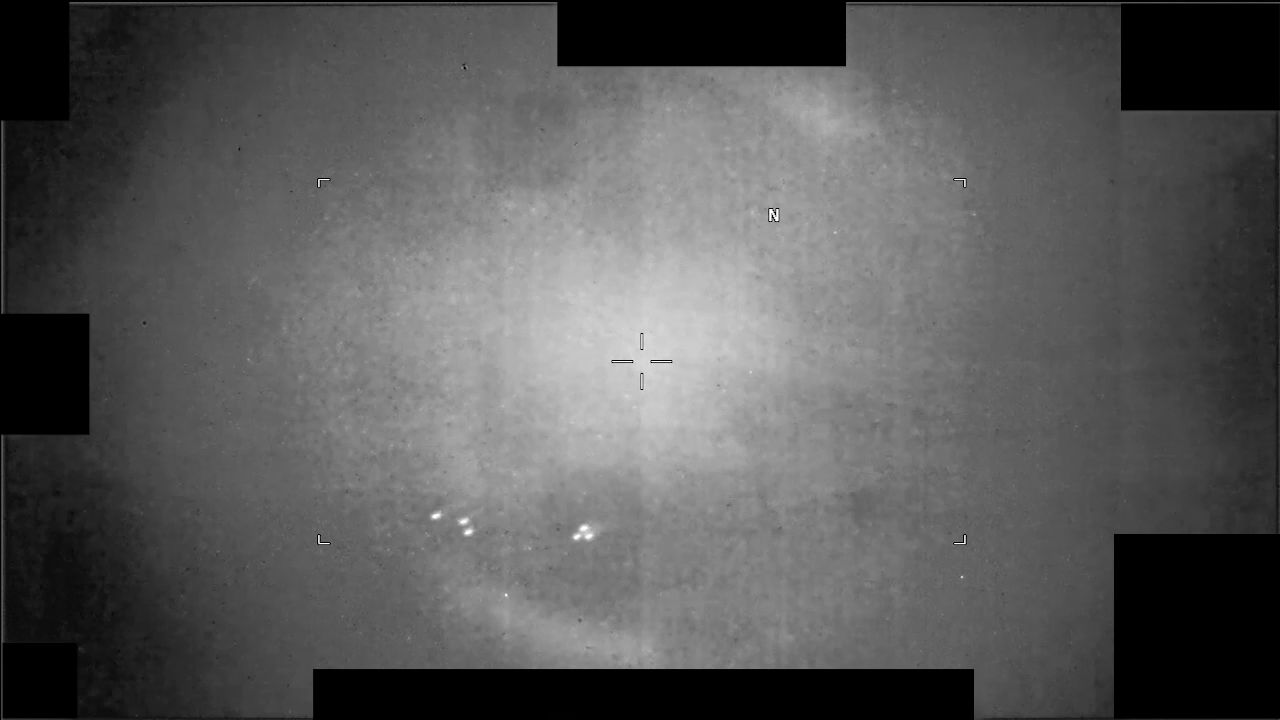
Several pale forms cross the infrared display. The sensor turns to follow them.
They remain together, their arrangement shifting as the camera holds them in view. There is no sharp outline to recognise, no fuselage or wing which settles the question. Before a minute has passed, the released sequence is over.
The accompanying report is more definite. Six small spherical objects. Rapid changes of direction. An estimated speed of 480 miles per hour.
Those details give the encounter its extraordinary character. They also leave a question hanging over the recording: how much of that apparent performance belonged to the objects, and how much to the way they were being observed?
A Contact During the Mission
The mission report places the initial contact at 20:22 UTC on 29 July 2025. It was submitted within U.S. Central Command’s area of operations and identifies the reporting unit as the 65th Special Operations Squadron.
Much of the surrounding operation is hidden behind redactions. The precise coordinates, aircraft type and aircraft altitude are withheld. Other details remain: the observing aircraft was travelling northwest, with an indicated airspeed of 120 knots.
The objects were recorded as travelling southeast. Their altitude was entered as flight level 220, approximately 22,000 feet on the standard pressure reference used in aviation. Both altitude and speed were marked as estimates.
It is a working military document, with fields completed, left blank or concealed. The unfamiliar observation sits among the timings and tasks of a longer flight. [1, pp. 1–2, 6–8]
The Words Beside the Pictures
The operator described the group as spherical and apparently agile, capable of changing direction quickly and together.
Other entries are less dramatic. The report records no response to the observer’s actions, no effects on equipment and no recovered material. Whether the objects were under intelligent control was entered as unknown.
There is a distinction between those observations and the conclusions sometimes attached to them. The report preserves an encounter which the crew could not identify. It does not establish an unfamiliar technology.
The official release makes a similar separation. Its description explains what appears in the video, while expressly withholding an analytical judgement about the event’s nature or significance. [1, pp. 6–7; 2]
The Evidential Divide
The recording: several bright forms crossing an infrared field of view and being tracked.
The mission report: the crew’s description of their shape and behaviour, together with estimated speed and altitude.
The missing measurement: a confirmed distance to the objects, needed to reconstruct their motion securely.
The Distance Between Camera and Object
The figure of 480 miles per hour is difficult to forget. Its meaning depends on a distance which the public record does not establish.
A camera aboard an aircraft is moving through the scene it records. Its own movement changes the apparent positions of objects below or ahead of it. When the sensor turns, everything within the frame shifts again.
Without a reliable range, a small nearby object can be assigned the scale and movement of something much farther away. A group turning together on the screen need not have made a simultaneous turn through the air.
This does not dispose of the encounter. It explains why the number written in the report cannot simply be read back from the film.
Nor is the public record entirely empty of useful information. The aircraft’s reported direction and indicated airspeed survive. The task is to establish what can be recovered from those fragments, without filling the remaining spaces with assumptions.
A Rhythm in the Brightness
On 6 October 2026, Jacob Haqq-Misra and colleagues published a preprint examining the recording frame by frame.
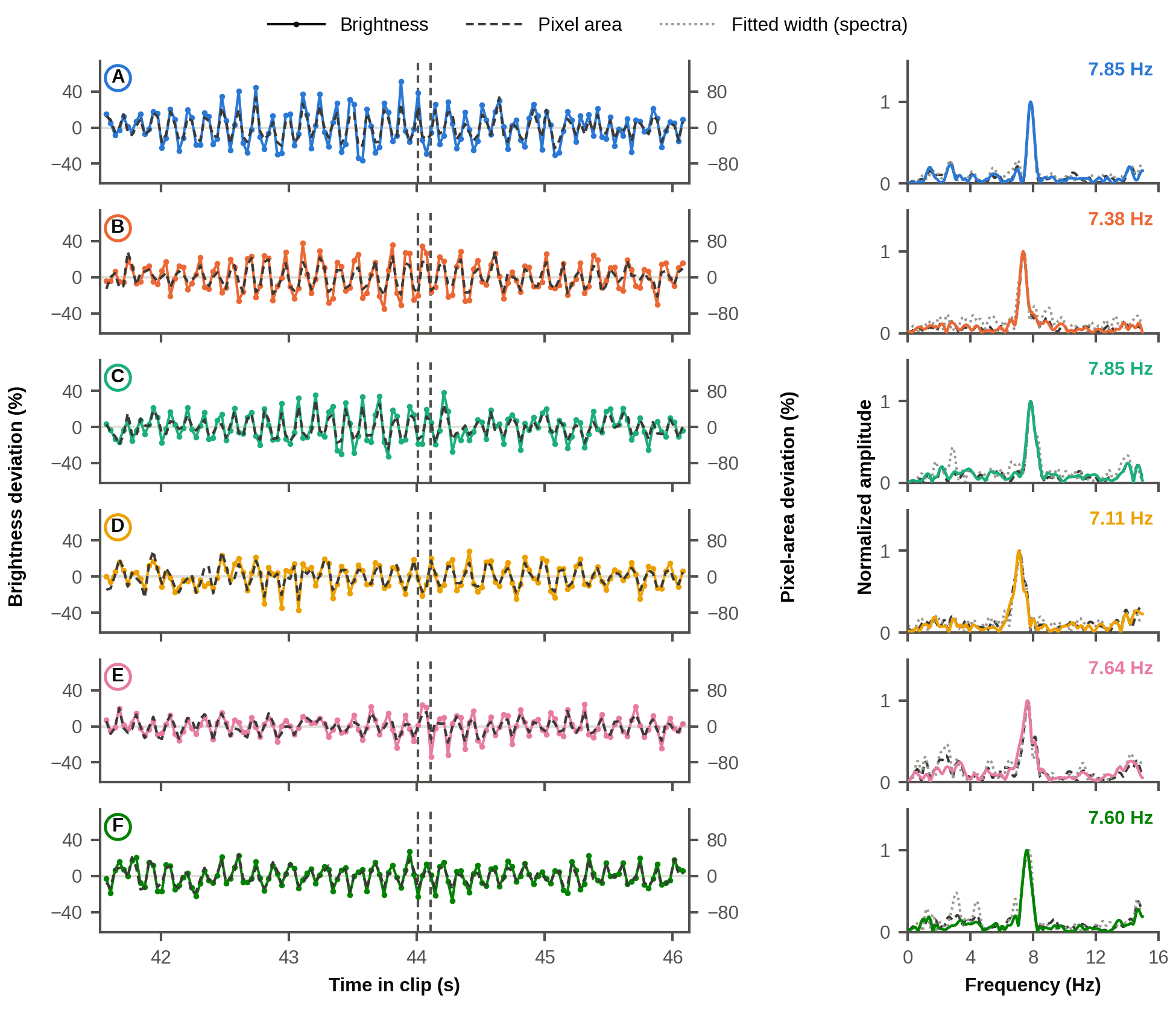
They reported that all six objects brightened and dimmed at approximately 7.1–7.9 cycles per second, each with its own timing. Their tests argued against compression and sensor defects as the source of the pattern. Comparisons with infrared recordings of flying animals supported a wingbeat interpretation.
The authors favoured a flock of birds closer to the aircraft than the crew had assumed. Their modelling also showed how viewing geometry could produce the reported apparent speed without requiring fast-moving objects.
The paper remained under review when this report was updated. It offers a testable explanation, rather than an official identification. The aircraft’s withheld altitude remains important, and the reported height of the objects presents a difficulty for an ordinary bird-flight interpretation. [3, 4]
Examine the Released Record
Viewing Guide: What Happens in the Clip
Opening seconds: the official description records no content during approximately the first four seconds.
About 5–10 seconds: several areas of contrast cross from the top towards the bottom of the sensor’s field of view.
About 11–47 seconds: the sensor pans to follow the group, keeping it generally near the centre.
Final seconds: magnification changes, and the official description records no further content.
This guide paraphrases the publisher’s description. It describes the sequence, not the objects’ identity.
Original Record
The Released Mission Report
The eight-page document retains the observation within its operational setting. The UAP entries appear principally on PDF pages 6–7; the opening narrative also records the date and time.
Document DOW-UAP-D108. Released with redactions; original classification markings remain visible alongside the declassification notices.
Archive Assessment
The recording and mission report have an established official provenance. That establishes where the material came from; the identification of what it depicts is a separate question.
The original description deserves to remain beside the images. So do the qualifiers in the form itself: estimated altitude, estimated velocity, unknown control. Removing those words would make the encounter sound more certain than its own record allows.
The October analysis gives the bird explanation evidential weight beyond a resemblance noticed by a viewer. It should now form part of any account of the case. It does not justify presenting every detail as settled.
For the moment, the public file contains both an unusual observation and a developing explanation. The bright forms remain indistinct. The claims made about them can nevertheless be examined.
Archive Classification
Authentic / Unresolved
Authentic released military material. A subsequent preprint supports a bird explanation, but the available record does not establish a final identification or independently verify the reported extraordinary performance. “Authentic” refers to the material’s provenance.
Key Facts
- Contact: 29 July 2025, approximately 20:22 UTC.
- Location: Middle East; precise coordinates redacted.
- Reporting command: U.S. Central Command.
- Reporting unit: 65th Special Operations Squadron.
- Reported objects: Six small spherical forms travelling together.
- Reported performance: Approximately 480 mph and flight level 220; both entered as estimates.
- Released evidence: Video DOW-UAP-PR135 and mission report DOW-UAP-D108.
- Public release: 18 September 2026.
- Review date: 16 October 2026.
Continue Through the Archive
The Nimitz encounter brings together military witnesses and sensor evidence of a different kind. At Calvine, the surviving record centres on a photograph whose original negatives remain missing.
Explore The Nimitz Tic Tac Encounter and The Calvine Photograph, or browse the Aerial Phenomena collection.
Sources
- U.S. Department of War — DOW-UAP-D108, Mission Report, Middle East, 2025. Eight-page released document; especially PDF pages 1–2 and 6–8. Contact dated 29 July 2025. Public release: 18 September 2026.
- All-domain Anomaly Resolution Office / DVIDS — DOW-UAP-PR135, Unresolved UAP Report, Middle East, 2025. Video ID 1023397; filename DOD_111985782. Published 18 September 2026. Official description and public-domain designation.
- Jacob Haqq-Misra, Ravi Kopparapu, Richard Cloete, Omer Eldadi, Michael Shermer and Abraham Loeb — “Six objects reported at 480 mph in a declassified military infrared video show brightness flicker at bird wingbeat rates.” arXiv:2610.08692, version 1, 6 October 2026. Preprint; submitted to Scientific Reports.
- Jacob Haqq-Misra — accompanying reproduction package, Zenodo, version 1, 6 October 2026. DOI: 10.5281/zenodo.23021686. Includes analysis code, derived measurements, figures and source files.
Further Reading
The October analysis can be read as a web page or PDF. It is linked rather than reproduced here. Its status as a preprint should be retained when citing its conclusions.
The supporting research package provides the material needed to examine and reproduce the measurements: Zenodo research record.
Garrett M. Graff — UFO: The Inside Story of the US Government’s Search for Alien Life Here—and Out There. Background reading on the wider history of official investigations; not a source for this encounter. Find on Amazon UK.
Image, Video and Document Credits
Header image and video: U.S. Department of War / All-domain Anomaly Resolution Office. Recording DOW-UAP-PR135, distributed through DVIDS and identified there as public domain. The header is a frame derived from the released recording.
Brightness-analysis chart: Figure 2, Haqq-Misra, Kopparapu, Cloete, Eldadi, Shermer and Loeb, 2026. Distributed in the accompanying Zenodo research package, DOI: 10.5281/zenodo.23021686, under the Creative Commons Attribution 4.0 International licence. Displayed at reduced size; no other editorial alteration.
Mission report: DOW-UAP-D108, released U.S. government document. The hosted copy retains its redactions and declassification markings.
The appearance of U.S. Department of War (DoW) visual information does not imply or constitute DoW endorsement.
Official video record · DVIDS reuse terms.
Editorial note: the date is taken from the mission report, rather than the generic year-only dating of the video entry. Speed and altitude remain attributed estimates. The October research is identified as a preprint and is not presented as an official case resolution.