A complete, concise Archive account of a case whose surviving record does not support a full investigation.
North-western Roman Empire · Approximately second to fourth centuries CE
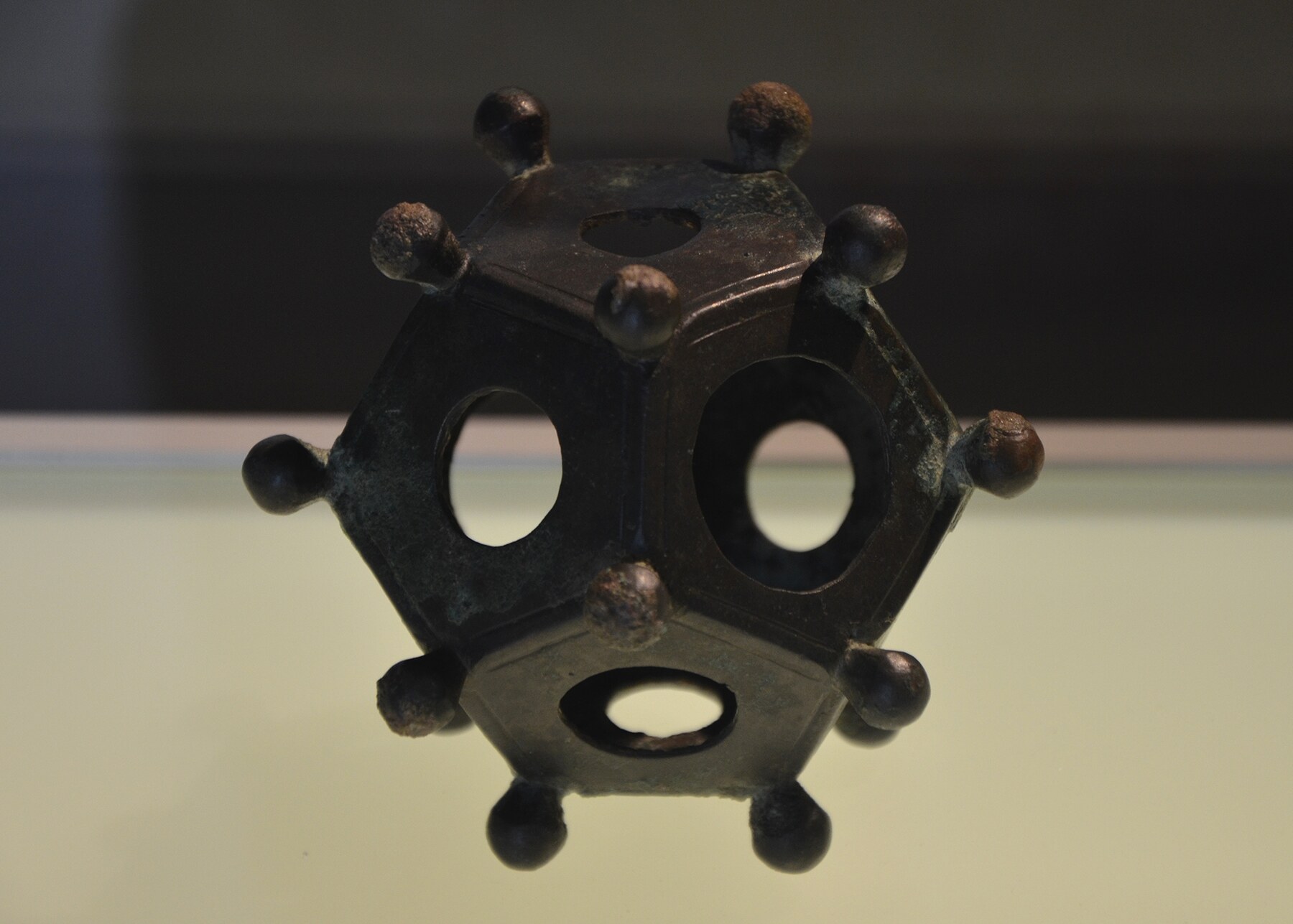
One metre beneath a Lincolnshire field, in what had once been a Roman quarry pit, a shape emerged from the soil. It was small enough to hold in one hand, cast from copper alloy and almost perfectly preserved. Twelve pentagonal faces enclosed a hollow centre. Each face carried a circular opening; each corner ended in a rounded knob.
The excavation team at Norton Disney recognised it immediately. This was a Roman dodecahedron—one of archaeology’s most distinctive unidentified objects. Around 130 examples are now known. The Romans left descriptions of engineering works, recipes, accounts, games and religious observances, yet no surviving text or image tells us what these elaborate objects were called or why they were made.
Twelve Faces, No Name
Each dodecahedron looks like carefully designed equipment. Every face has a differently sized circular opening, sometimes surrounded by engraved rings, while twenty knobs mark the corners. Most examples measure roughly four to eleven centimetres across.
Placed alongside one another, the apparent system begins to loosen. Their dimensions, weights, decoration and sequence of apertures differ. There are no numbers, scales, makers’ marks or inscriptions. Broken examples reveal walls surprisingly thin for such complex castings.
The map adds another clue without supplying an answer. Finds extend across the northern and western provinces of the Roman Empire—including Britain, Gaul, Germania and territories towards the Danube—but are notably absent from the Mediterranean heartlands. Often called Gallo-Roman dodecahedra, they appear to belong to a regional practice rather than Roman life everywhere.
The Missing Instruction
That regional pattern might have provided a way forward if the people who used the objects had left a description. Instead, an object made repeatedly over several centuries has no surviving name and no secure representation of itself in use. No known sculpture, mosaic, painting or manuscript shows a person holding or mounting one.
Nor has the ground supplied one consistent setting. Better-recorded finds have appeared in forts, settlements, baths, graves, hoards and discarded material. Dodecahedra may have served more than one purpose, or valuable objects may have passed through several uses before burial.
THE EVIDENTIAL DIVIDE
What survives: approximately 130 related objects, their metals, measurements, decoration, distribution and—in a smaller number of cases—controlled excavation contexts. What is missing: an ancient name, written description, illustration or object found unambiguously in use. Modern replicas can show that a theory is possible; they cannot demonstrate that it is historically correct.
What Were They For?
The openings naturally invite practical explanations. In the most technical version, the dodecahedron was a measuring or sighting instrument. Looking through two holes of different diameters can create a fixed field of view, allowing a user with known values to estimate distance or size. Yet the objects are not standardised and carry no calibration marks. Each would require its own set of values, none of which survives.
If the holes were intended to hold rather than sight something, a candleholder becomes possible. Traces of wax have been reported on some examples, and a dodecahedron can stand on its knobs. The problem is proportion: an intricate and costly casting seems unnecessary for a function already served by ordinary Roman lamps and holders, while wax could reflect later reuse.
A more persuasive demonstration comes from the popular textile-tool theory. Reproductions can produce tubes resembling glove fingers when yarn is looped around the knobs. It works—but no ancient textile, written source or wear pattern connects dodecahedra to knitting, and the holes do not determine the finished tube’s size as sometimes claimed.
When practical explanations falter, the object’s twelve faces suggest a game, puzzle or divination device. The projecting knobs make it an awkward die, however, and the unnumbered faces preserve no evident rules. Coloured or inscribed inserts may once have occupied the openings, but none has been securely identified.
That leaves a ritual or symbolic purpose: difficult to prove, but equally difficult to dismiss. In classical philosophy the dodecahedron could represent the ordered cosmos, and some examples come from graves or hoards. The craftsmanship and limited distribution may point to status, ceremony or a regional religious tradition. This reading explains why no practical instruction survives, but it also carries a danger—turning an absence of evidence into evidence of secrecy.
What Norton Disney Changed
For years, these theories had to compete over objects whose original surroundings were poorly recorded. Then, in June 2023, the Norton Disney dodecahedron emerged during a controlled excavation. Complete, unworn and finely made, it was provisionally dated to the late third or early fourth century. Its position could be revisited rather than reconstructed from an antiquarian note.
When the team returned in 2024, the promising context became more complicated. The object had come from a former sand quarry later backfilled with pottery, bone, masonry and other debris. A mid-third-century coin and pottery helped date the filling. Further work in 2025 and 2026 uncovered pits, ditches and evidence of an industrial area associated with the nearby Roman villa estate.
The excavation therefore narrowed the history of this particular object without revealing its use. It may have been deliberately deposited, accidentally lost or discarded with material brought from elsewhere. Norton Disney replaced an almost contextless find with a documented one—and demonstrated how far even careful archaeology can remain from recovering an object’s meaning.
Archive Assessment
The Roman dodecahedra are a genuine archaeological mystery. Their age, manufacture and distribution are established; the uncertainty concerns function. Nothing about the objects requires a lost civilisation or impossible technology. Their strangeness lies in something quieter: a recognisable Roman-era design whose meaning disappeared completely.
Practical reconstructions remain valuable tests, but several activities can be performed with the same shape. A successful demonstration is not an identification. No theory yet accounts convincingly for the objects’ regional distribution, costly manufacture, variable dimensions, diverse contexts and absence from Roman imagery.
The Archive classifies the Roman dodecahedra as an authentic and unresolved ancient artefact tradition. A specialised practical purpose remains possible, but the present evidence may fit a regional symbolic or ceremonial role more comfortably than any proposed universal tool.
KEY FACTS
- Date: Principally second to fourth centuries CE
- Region: Northern and western provinces of the Roman Empire
- Known examples: Approximately 130; 33 recorded from Roman Britain
- Construction: Hollow cast copper alloy, usually with twelve perforated faces and twenty corner knobs
- Typical size: Approximately 4–11 centimetres
- Ancient explanation: None known
- Status: Authentic artefacts; function unresolved
Continue Through the Archive
For a full investigation into another ancient achievement whose genuine qualities have attracted increasingly elaborate claims, continue with The Barabar Caves: The Polished Enigma in the Ancient Mysteries collection.
Sources
- Hill, Christopher. “Gallo-Roman Dodecahedra: A Progress Report.” The Antiquaries Journal, volume 74, 1994, pp. 289–292.
- Guggenberger, Michael. “The Gallo-Roman Dodecahedron.” The Mathematical Intelligencer, volume 35, issue 4, 2013, pp. 56–60.
- Hitchens, Lorena. “Roman Dodecahedron,” in the archaeological evaluation report for Norton Disney, Lincolnshire, 2024.
- National Civil War Centre, Newark. “Norton Disney Dodecahedron,” including the results of the 2024–2026 excavations.
- Portable Antiquities Scheme, copper-alloy Roman dodecahedron record and image, FindID 246648.
Further Reading
- de la Bédoyère, Guy — Roman Britain: A New History. Find on Amazon UK.
- Moorhead, Sam and David Stuttard — The Romans Who Shaped Britain. Find on Amazon UK.
Image credit: Roman dodecahedron in the collection of the Gallo-Roman Museum, Tongeren. Photograph by Carole Raddato, licensed under CC BY-SA 2.0. The image has been resized for web presentation.