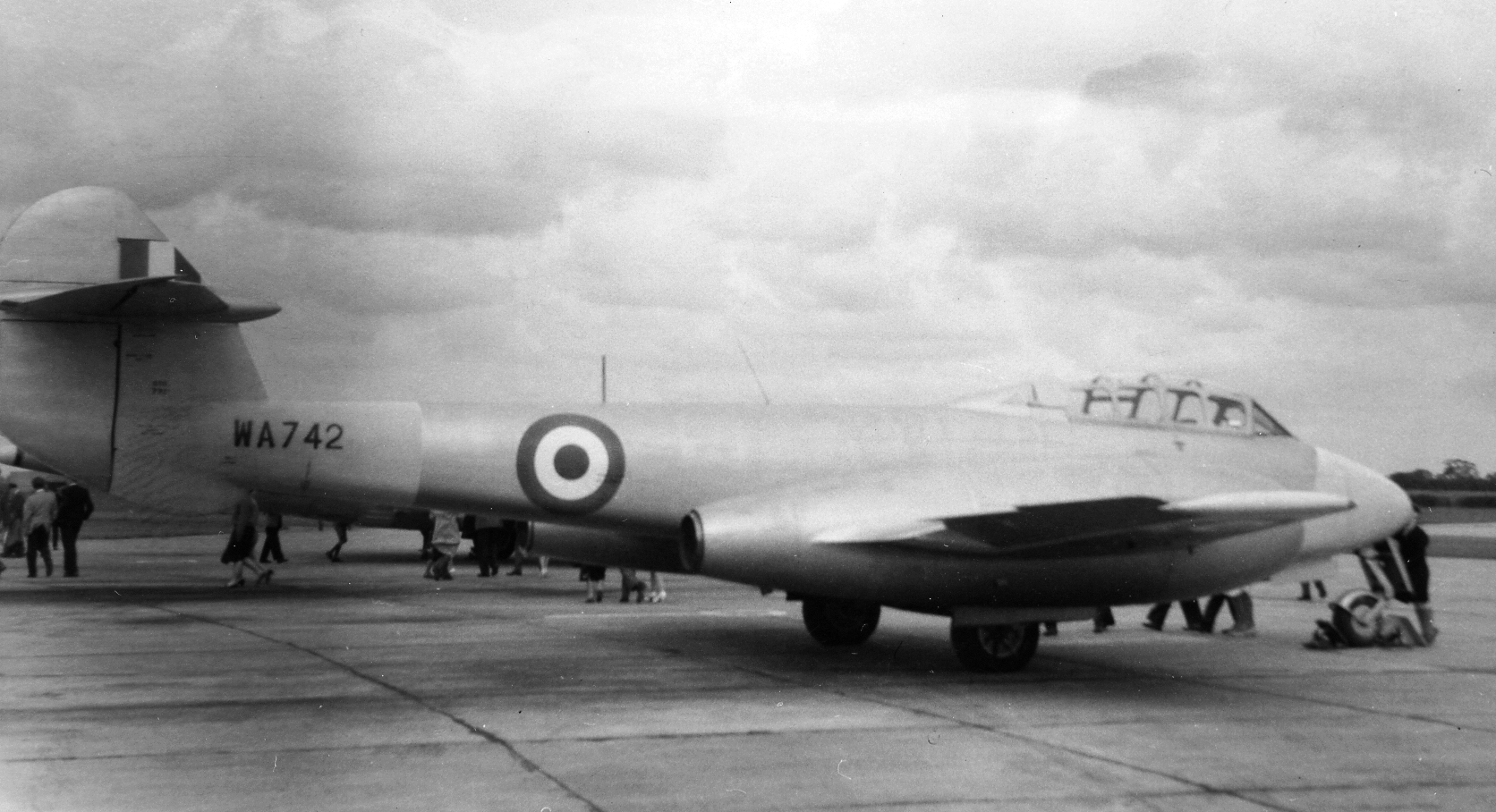
A complete, concise Archive account of a case whose surviving record does not support a full investigation.
Gloucestershire, England · 21 October 1952
A Gloster Meteor climbed through cloud above the Cotswolds. In its cockpit were two military airmen engaged in a routine training exercise: Flight Lieutenant Michael Swiney of the Royal Air Force and his student, Royal Navy Lieutenant David Crofts. When the aircraft emerged into clear sky, three pale shapes were waiting above them.
Swiney’s first thought was reassuringly ordinary. They looked like parachutes. But the objects did not continue to fall, and both men saw enough to abandon the exercise. By the time the Meteor returned to RAF Little Rissington, an uneventful training flight had become an Air Ministry matter—and, decades later, almost all of its paperwork had disappeared.
The Known Account
Swiney was an instructor with the Central Flying School at RAF Little Rissington. Crofts occupied the second seat of the Meteor T.7, one of Britain’s early jet trainers. Their flight took place during an unusually active period for British reports of unidentified objects. Only a month earlier, RAF personnel at Topcliffe had described a silver object behaving strangely during the NATO exercise Mainbrace.
The most detailed version of the Little Rissington encounter comes from interviews conducted in 2004. Swiney and Crofts recalled breaking through cloud at approximately 12,000 feet and seeing three circular or elliptical objects higher in the sky. Crofts compared their appearance to pieces of glass reflecting sunlight. Swiney remembered them as plate-like—sufficiently like the popular image of a flying saucer for him to use that term in his logbook.
The training exercise was cancelled. Later recollections say that ground radar detected unusual returns, that fighters were sent to investigate and that no interception was made. Swiney and Crofts also remembered being questioned the following day, when statements and drawings were taken. What those documents contained—and how closely they matched the story remembered fifty-two years later—can no longer be checked.
What the 1952 Record Preserves
One contemporary entry survives in the Operations Record Book of RAF Little Rissington. Its wording is brief, but unusually direct. It records that the Meteor’s crew sighted three mysterious “saucer-shaped objects” travelling at high speed at about 35,000 feet during a high-level navigation exercise. It also states that air-traffic control subsequently reported radar plots that appeared to support the sighting.
The same entry closes the matter more firmly than the evidence now permits: the Air Ministry discounted the possibility that the objects were extraterrestrial. That was a conclusion about what they were not, rather than a surviving identification of what they were.
THE EVIDENTIAL DIVIDE
Recorded in 1952: two airmen, three saucer-shaped objects, high apparent speed and radar plots said to support the report. Recalled in 2004: the objects’ reflective appearance, the witnesses’ reactions, a fighter scramble, an estimated speed and the subsequent Air Ministry interviews. The later testimony may be sincere, but it is not interchangeable with the surviving contemporary record.
Where the Evidence Ends
Swiney later sought the original investigation papers and was told that many early unidentified-object records had been routinely destroyed. The witness statements, drawings and radar plots associated with the incident have not been found in the surviving file. This absence does not prove that damaging evidence was deliberately removed; routine disposal is a less dramatic and better-supported explanation. It does, however, leave the case balanced on a frustratingly narrow foundation.
The Operations Record Book confirms that something unusual was reported at the time. It does not preserve the duration of the observation, the precise geometry between aircraft and objects, the radar equipment involved, the original plots or the reasoning behind the Air Ministry’s conclusion.
What May Explain It?
Parachutes or balloons fit the witnesses’ first impression and the pale, reflective appearance remembered later. They fit less comfortably with the contemporary description of high-speed movement, although without the original statements it is impossible to know how that speed was estimated.
Atmospheric or optical effects could produce bright shapes above cloud and make distance difficult to judge. Three apparently solid, clearly bounded objects seen by two observers are not automatically explained by glare or reflection, but neither witness had a reliable scale or measured distance from which true size and speed could be calculated.
Radar confirmation sounds decisive, but the missing plots matter. Early radar could produce anomalous returns from birds and unusual atmospheric conditions. The surviving entry says the plots appeared to support the visual report; it does not provide enough information to demonstrate that the radar and the airmen were observing the same targets.
An unfamiliar aircraft cannot be excluded simply because the airmen did not recognise what they saw. Yet no documentary evidence has emerged identifying a British, allied or foreign aircraft that matches the report. The more extraordinary extraterrestrial interpretation has the same problem in greater form: the record establishes unidentified objects, not their origin.
Archive Assessment
The Little Rissington encounter deserves to be remembered because it is more than a story recovered from a witness many years later. A contemporary RAF record confirms that two military airmen reported three unusual objects and that radar plots were thought to lend support.
But the case becomes less secure as its detail increases. The closer we move towards the dramatic version—fighters scrambled, extraordinary speed, intensive questioning—the more dependent we become on recollection after half a century. The original evidence that might have tested those memories is gone.
The Archive classifies the Little Rissington encounter as unresolved but evidentially limited: a genuine official report whose surviving record is too slight to identify the objects or confirm the full later narrative.
KEY FACTS
- Date: 21 October 1952
- Location: Airspace associated with RAF Little Rissington, Gloucestershire
- Witnesses: Flight Lieutenant Michael Swiney and Lieutenant David Crofts, Royal Navy
- Aircraft: Gloster Meteor T.7 jet trainer
- Reported objects: Three pale, circular or saucer-shaped forms
- Surviving evidence: One entry in the RAF station Operations Record Book
- Status: Unresolved; original statements and radar material do not survive in the available file
Continue Through the Archive
For fuller investigations involving military witnesses, official records and disputed imagery, continue with The Nimitz Tic Tac Encounter and The Calvine Photograph in the Aerial Phenomena collection.
Sources
- RAF Little Rissington, Operations Record Book, October 1952, The National Archives, AIR 29/2310.
- David Clarke, The UFO Files: The Inside Story of Real-Life Sightings, The National Archives, 2009; including the author’s 2004 interviews with Michael Swiney and David Crofts.
- The National Archives, UFOs research guide and digitised extract from The UFO Files.
Further Reading
- Clarke, David — The UFO Files: The Inside Story of Real-Life Sightings. Find on Amazon UK.
- Ruppelt, Edward J. — The Report on Unidentified Flying Objects, 1956; useful contemporary context for official military interest in unidentified aerial reports.
Image credit: “Meteor T7” by TSRL, Wikimedia Commons, licensed under CC BY-SA 3.0. The aircraft shown is the correct variant but is not the Meteor flown during the encounter.