
Key Facts
- Location: near Kendu Bay, Homa Bay County, Kenya.
- Tradition: Luo folklore associated with Lake Simbi Nyaima.
- Date: the tale is undated; published versions include an account from 1903.
- Central account: a stranger asks a prosperous community for food and shelter.
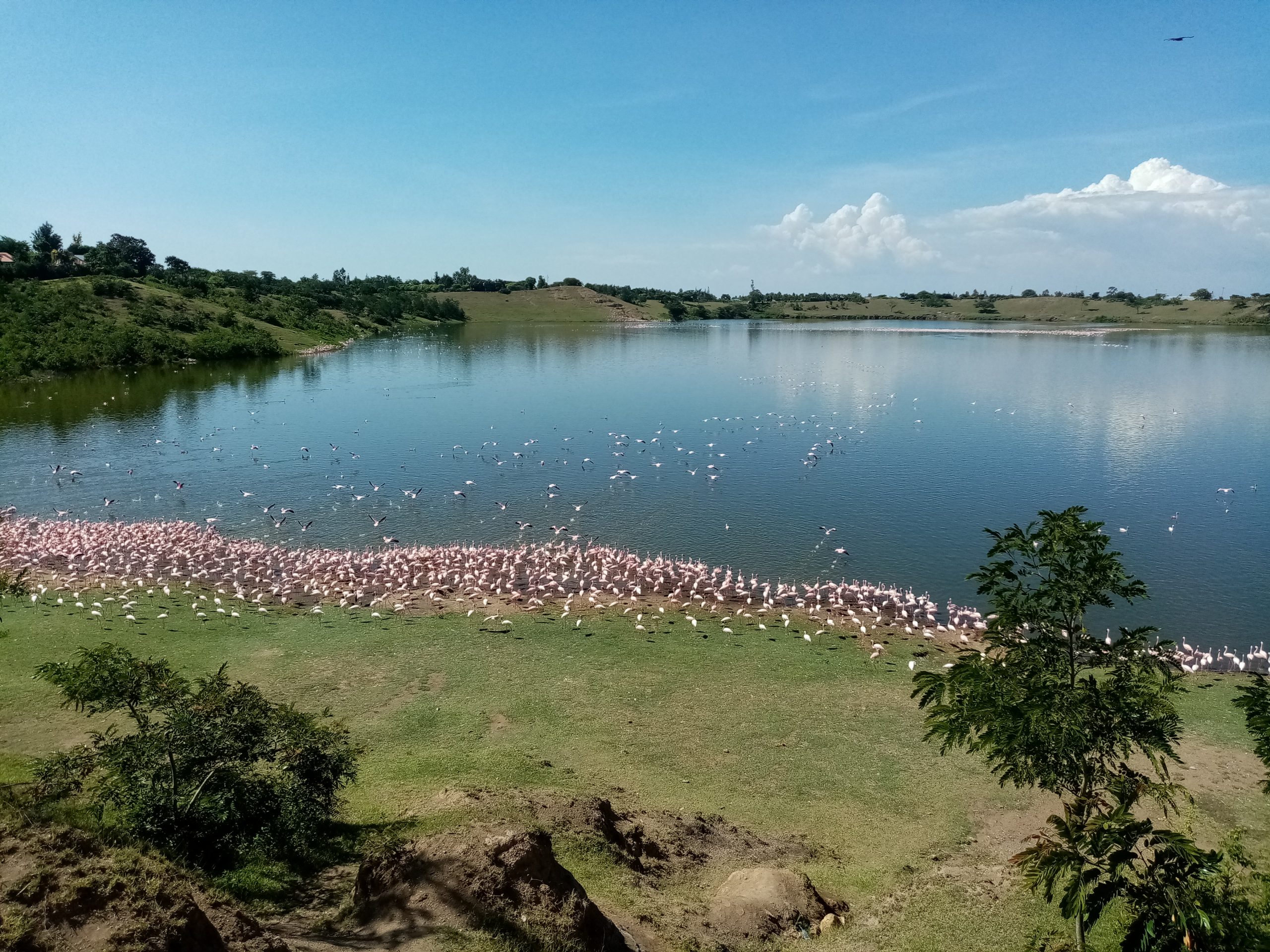
Near Kendu Bay, in western Kenya, flamingos gather on a small lake. Homes overlook the water, and Lake Victoria lies close by. But Simbi Nyaima has a story of its own.
In the Luo tradition told about this place, a village once stood where the water is now. Its people were celebrating when an unfamiliar woman arrived. There was meat to eat and beer to drink. She asked for food and somewhere to rest.
They sent her away.
What followed gave the lake the name by which it is widely known: the village that sank.[1][2]
The Stranger at the Feast
The story has been told in different ways. In a version recorded in a study published in 2014, the celebration takes place at Kolonde. The men are drinking and eating, while women keep the feast supplied. The stranger’s appearance and smell repel the gathering. Her request for shelter goes unanswered, and men escort her out.
In a neighbouring village, a young mother welcomes her. She gives her food and a place beside the fire. When the visitor asks where her husband is, the mother explains that he has gone to the feast.
The stranger asks her to fetch him. But when he hears who is waiting, he strikes his wife and refuses to come.
She returns home and tells her guest what has happened. Now the stranger gives her a warning: take the children and leave.
As they get away, rain and lightning break over the villages. The downpour lasts through the day and night. Water rises, the ground occupied by the inhospitable settlement disappears, and the people and animals within it are lost.
The mother and her children have escaped. Behind them, the place of the feast has become a lake.[1]
A Woman with Power over Rain
In 1903, the colonial official C. W. Hobley published another version. Here, the stranger goes from house to house before one woman offers her food and water. The visitor calls that woman’s husband from a drinking gathering. This time he comes, and both husband and wife follow her out of the village.
When they have gone a little way, she throws something back towards the houses. There is a tremendous noise. Rain pours down, and by morning the village is under water.
In this account, the stranger’s journey continues. She crosses the gulf and finds another household willing to receive her. But her presence brings unease: when she raises her eyebrows, her eyes give off sparks of fire. Eventually she leaves again and marries into a family to whom she teaches the secrets of rainmaking.
Hobley records the tale as an explanation of how a line of rainmakers acquired its powers. The destruction of the village is one part of the stranger’s longer journey.[3]
What Changes in the Telling
In one version, a husband listens and lives. In another, his refusal leaves his wife to escape with their children. The celebration changes too. Some tellings make it a wedding, others a harvest feast. In a modern Kenyan retelling published by Paukwa, several days pass between the warning and the rain.[1][4]
At the centre of each is the same troubling encounter. A community has plenty, yet turns away someone in need. One household offers kindness. Only afterwards does anyone discover how much depended on that choice.
The stranger’s power gives the story its terror. She can bring down a village, but she first appears as someone the villagers believe they can safely ignore.
How Old Is the Lake?
Some accounts place the lake’s formation only a few centuries ago. The 2014 study gives a date of about 1680. Read today, that would put its beginning less than 350 years in the past: close enough for the disaster to seem within reach of remembered family histories.[1]
But research into the mud beneath the water tells a longer story. A study published in 2018 examines a sediment record spanning about 1,200 years. An earlier paper, published in 1997, describes deposits dated to several thousand years ago. Those findings point to a lake much older than the seventeenth century.[7][8]
The 1680 date therefore belongs among the published accounts of Simbi; it should not be presented as an established date for the lake’s birth. The sediment studies do not, however, tell us when the tale first took shape.
The Ground and the Story
Simbi occupies a volcanic explosion crater, known as a maar, associated with the Homa Mountain complex. The Smithsonian’s Global Volcanism Program notes the local legends suggesting a comparatively recent origin. The sediment research gives us a reason to be cautious about that suggestion.[5]
It is tempting to look for a particular disaster behind the tale. Might a flood, a collapse of ground or some other upheaval have been remembered and retold? Perhaps. But no event has been securely matched to the story in the sources examined here. An older lake could have witnessed later changes; that possibility alone does not show that it did.
There is also no archaeological confirmation of the lost village in the material reviewed for this report. The water gives the story a place. It has yet to give us the houses.
What the Water Keeps
Simbi Nyaima belongs to the people living around it as well as to the stories told about it. Studies of the site describe its place in local life, from the harvesting of salts along its shore to efforts to care for it and welcome visitors. Its name carries a history that people continue to tell.[1][6]
The stranger remains the unsettling presence at the heart of that history. The tellings leave room for different understandings of her: a punishing visitor, a woman with command of rain, a figure whose journey reaches beyond the lake. Her request, though, is easy to understand.
Before the storm, she is hungry. Before anyone knows what she can do, she asks for shelter. Every time the story is told, the village has that moment again: someone is at the door, and there is still time to let her in.
Archive Assessment
Evidentially Limited
This classification concerns the claim that a village disappeared beneath the lake. The Luo tradition is documented, but the sources examined do not establish the submerged settlement or identify a disaster behind the tale. Sediment research points to a lake much older than the sometimes-published date of 1680.
Read the Field Study
The complete 2014 study by Patrick O. Hayombe, Fredrick Z. A. Odede, Stephen G. Agong’ and Lena Mossberg considers Simbi Nyaima’s landscape, oral tradition and cultural importance. Its detailed telling appears on printed pages 180–181, corresponding to PDF pages 8–9.
Originally published in the Journal of Arts and Humanities, 3(1), 2014, pp. 173–187. Reproduced unchanged under CC BY 3.0. Original publication and licence statement. The study records the tradition and discusses heritage planning. Its proposed formation date of about 1680 conflicts with the older sediment records discussed above.
Sources
- Patrick O. Hayombe, Fredrick Z. A. Odede, Stephen G. Agong’ and Lena Mossberg. “Simbi Nyaima: An Interplay of Nature and Mythology in the Lake Victoria Region; Planning and Management for Ecotourism Transformation in Kenya.” Journal of Arts and Humanities 3(1), 2014, pp. 173–187. Principal source for the main telling and the proposed 1680 date; especially pp. 180–181. Its dating claim is assessed against sources 7 and 8. Read the complete study.
- Kenya Wildlife Service. “Lake Simbi National Sanctuary.” Short institutional account of the lake and its associated tradition. Source.
- C. W. Hobley. “British East Africa: Anthropological Studies in Kavirondo and Nandi.” Journal of the Anthropological Institute of Great Britain and Ireland 33, 1903, pp. 325–359; relevant passage pp. 349–350. Read in an online OCR reproduction; paraphrased here, without treating the colonial author’s terminology as a neutral account of Luo beliefs. Readable reproduction; bibliographic record.
- Paukwa. “Simbi Nyaima.” Contemporary Kenyan retelling, used to compare narrative timing and details. Source.
- Smithsonian Institution, Global Volcanism Program. “Homa Mountain.” Geological summary identifying the Lake Simbi maar and noting the tradition-based suggestion of formation in historical times. Source.
- Celia Nyamweru. “Natural cultural sites of Kenya: changing contexts, changing meanings.” Journal of Eastern African Studies 6(2), 2012, pp. 270–302; discussion of Simbi on p. 290. Used for cultural context. Publication record.
- Daniele Colombaroli, Geert van der Plas, Stephen Rucina and Dirk Verschuren. “Determinants of savanna-fire dynamics in the eastern Lake Victoria catchment (western Kenya) during the last 1200 years.” Quaternary International 488, 2018, pp. 67–80; first available online in 2016. The publisher’s abstract and accessible section extracts describe a 1,200-year sediment record from Lake Simbi. Publication; university record.
- Joseph Mworia-Maitima. “Prehistoric fires and land-cover change in western Kenya: evidences from pollen, charcoal, grass cuticles and grass phytoliths.” The Holocene 7(4), 1997, pp. 409–417. The publisher’s abstract reports Lake Simbi sediments dated between approximately 4,320 and 2,880 years before present, with dating uncertainties. Abstract consulted; the complete paper was not available for assessment. Publication and abstract.
Further Reading
Nyamweru’s article places Simbi within a wider Kenyan discussion of culturally significant landscapes. For the lake’s environmental history, the sediment studies listed above offer a separate line of evidence.
Continue Through the Archive
Explore more Myths, Legends & Folklore, or return to the Archive Index.