A complete, concise Archive account. Free to read in full.
Lake, near Sandown, Isle of Wight · May 1973
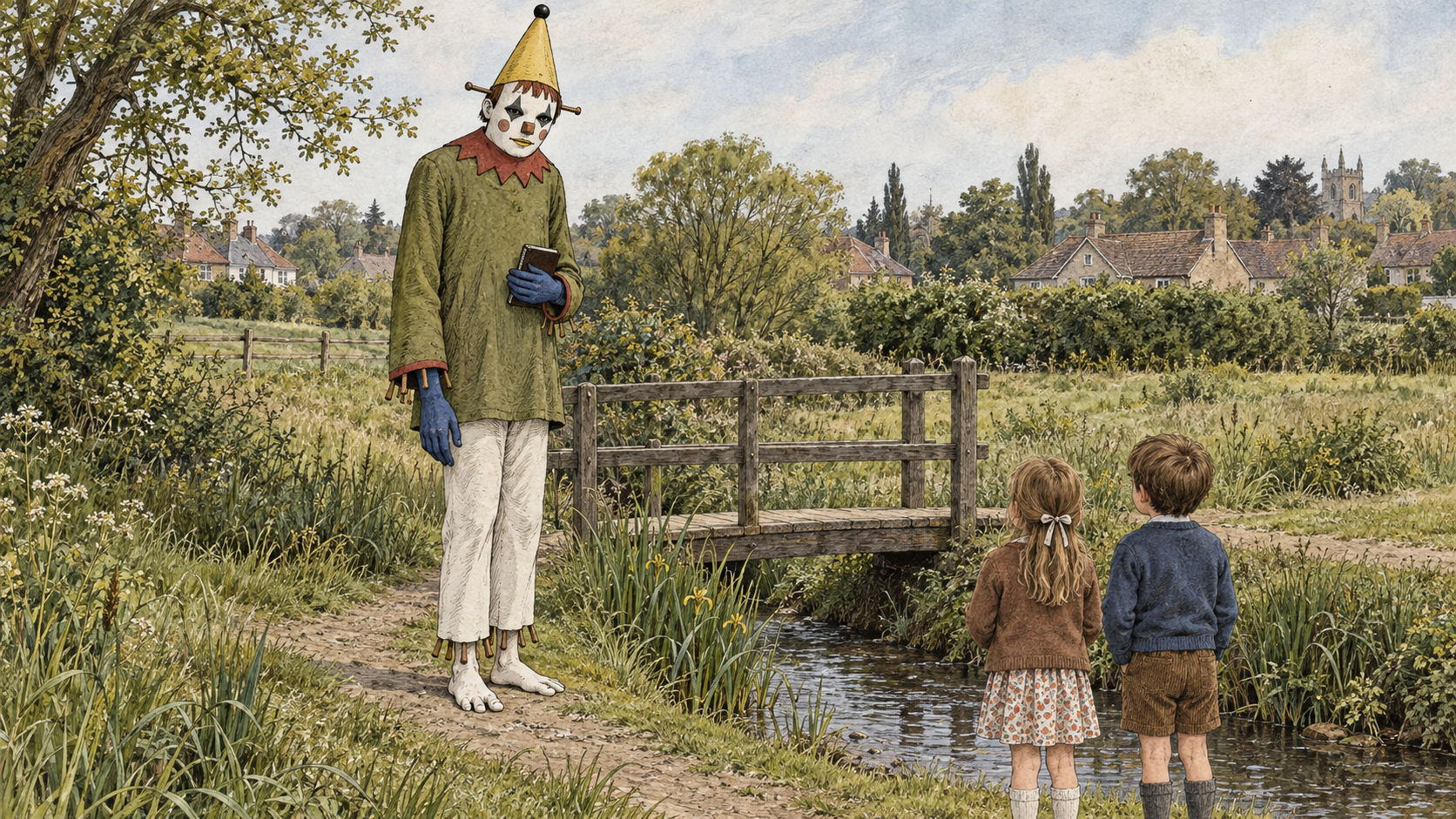
A blue-gloved hand appeared beneath a wooden footbridge. Then a figure, carrying a book, which it promptly dropped into the water.
In the account later published by the British UFO Research Association, two children watched it splash about in the brook, retrieve the book and move away across the grass, lifting its knees in a series of high steps. Nearby stood a metal hut.
It was about four o’clock on a Tuesday afternoon in May 1973. The children had followed a wailing sound across the golf links near Sandown, on the Isle of Wight. Now the sound had stopped, and the figure had gone inside.
They began to walk away. Then it came out again.
This time it was holding something resembling a microphone, with a black head and a white cable. The wailing returned, loud enough to send the boy running. When it stopped, a voice called after them. Its tone was friendly. Although the children were some distance away, they heard it as clearly as someone speaking beside them.
They went back. [1]
All Colours, Sam
The girl, identified in the published account as “Fay”, was seven. Her companion was about the same age. Before them stood a figure they estimated to be nearly seven feet tall, wearing a pointed yellow hat, a green tunic with a red collar, and white trousers. The hat seemed to meet the shoulders without a neck between them. Narrow pieces resembling wooden slats projected from the sleeves and trouser legs.
Its face was white. Triangular markings for eyes, a brown square for a nose, yellow lips. The lips did not move when it spoke.
The figure opened a notebook. Its words were scattered across the page rather than arranged in an ordinary sentence. Pointing to them one at a time, it guided Fay through an introduction:
“Hello and I am all colours, Sam.”
The name has stayed with the story. Sam the Sandown Clown. But the conversation that followed made even that identification uncertain. Asked what it was, the figure gave no clear answer. It also said it had no name.
The children’s questions were practical. Why were its clothes torn? Because it had only one set. Was it a man? No. Was it a ghost? Not quite, although its answer left room for the possibility.
Then it invited them inside. [1]
Inside the Hut
The hut had no windows. The children entered through a flap and found wooden furniture, an electric heater and blue-green walls covered with a pattern of dials. There were two levels, the upper one smaller, with a metal floor.
Sam said it collected berries and could clean water from the river to drink. Removing its hat revealed round white ears and sparse brown hair. Before eating a berry, it placed it in an ear, jerked its head and apparently brought the berry out at an eye. Another movement carried it to the mouth.
Fay described this as a conjuring trick.
That choice of words leaves an opening. A trick suggests a performer, someone doing something inexplicable for an audience. The hut, the microphone and the clothing might belong to such a person. But the children also described three fingers on each blue-gloved hand and three toes on the bare white feet. Their account moves between a person in costume and a body constructed differently from their own.
They remained for half an hour or more. When they left, they crossed the golf links and told a man they had met a ghost, or someone dressed as one. He laughed. [1]
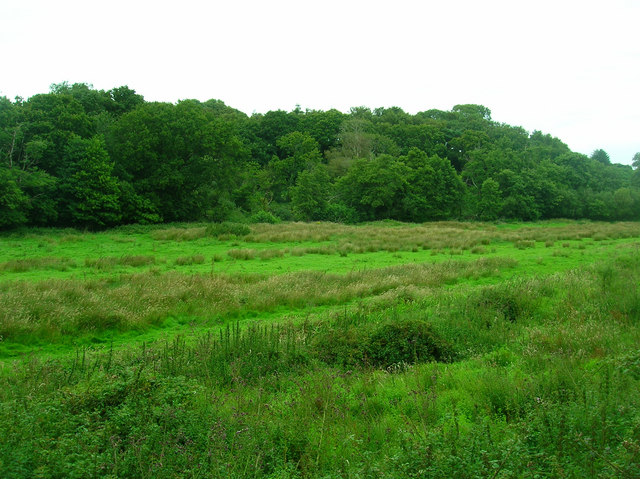
The place itself was ordinary enough. Lake is the name of the settlement adjoining Sandown; there was no lake beside the bridge. Scotchell’s Brook runs through the surrounding landscape, past development, wet grassland and former common land. The parish council traces the settlement’s name to the Old English lacu, referring to the watercourse.
The original account places the encounter near Lake Common, in marshy ground beside the airfield. It does not give us a bridge we can confidently identify today. The setting is recognisable. The precise scene remains beyond reach. [1–3]
The Father’s Account
On 2 June, some three weeks after the encounter, Fay told her father.
He initially found the story difficult to accept. According to the published account, he also spoke to the boy, who was less forthcoming but confirmed that he had seen the figure. The father visited the area himself. He found no metal hut, nor any sign of one.
By then, whatever had occupied that patch of ground—if anything had—was no longer available for examination.
The story reached Norman Oliver, editor of the BUFORA Journal, through UFO researcher Leonard Cramp. Oliver published it in January–February 1978 under the heading “Ghost or Spaceman ’73?” His introduction explains that he had condensed material supplied by the father, whose anonymity was preserved as “Mr Y”.
The father brought experiences of his own. He had reported unusual lights before his daughter’s encounter and wondered whether the events were connected. He also supplied one of the account’s most suggestive details: while the children spoke to the figure, two workmen nearby had apparently paid no attention.
To him, this raised the possibility that Fay had entered a separate pocket of reality. [1,5]
Yet the workmen’s silence can bear more than one reading. Perhaps they noticed nothing unusual. Perhaps they were occupied with their work. We have no statement from either man establishing what was visible from where they stood. A detail that seems to support an extraordinary explanation also exposes the absence of another viewpoint.
Read the Original Published Account
“Ghost or Spaceman ’73?” appears on printed pages 9–13 of the January–February 1978 BUFORA Journal, corresponding to PDF pages 11–15.
The original issue is linked through BUFORA’s archive. Its pages and artwork are not reproduced here.
Behind the Face
The figure’s fixed mouth, geometric face, projecting slats and awkward movement have encouraged a robot-like interpretation. Later retellings have drawn out that mechanical quality. It is easy to picture an automaton beneath the clothes, or a machine made to resemble a person. [4]
There is also the possibility of an extraterrestrial visitor. The original article’s title asked whether the figure was a ghost or a spaceman, placing that question alongside the account from the outset. Its unfamiliar appearance, unusual voice and the metal structure nearby make it possible to imagine a visitor from elsewhere. [1]
In that interpretation, the hut could have been a spacecraft. The children described a metal exterior, two levels and walls patterned with dials. When Fay’s father searched the area weeks later, he found no sign of it.
But the published account does not describe the hut taking off or moving. Nor does it establish where the figure came from. A spacecraft is one way to picture the structure; the children’s description does not identify what it was or explain its absence when the father visited.
A person in costume offers another possibility. A mask could account for the fixed face, while the clothing and microphone-like object might belong to a performer. The berry trick offers a possible foothold for that reading, although no performer has been identified in the material examined here.
The figure’s own answers also leave room for a ghostly or otherworldly interpretation. Fay’s father went further, wondering whether the encounter and the apparent indifference of the workmen pointed to a separate pocket of reality. That was his interpretation of the account, not something the workmen themselves confirmed. [1,5]
Childhood storytelling remains another possibility. Two children can build a narrative together, retaining details that adults find difficult to account for. But that is a proposed explanation, not a recovered history of this particular afternoon. The surviving publication cannot take us back into their first conversations.
Nor does the paper trail end entirely in 1978. In 2024, AFU and Flying Disk Press published The Isle of Wight Entity Case, described as a facsimile of the original file held by Archives for the Unexplained in Sweden. Its advertised contents include correspondence, drawings, maps and newspaper cuttings. The full volume has not been examined for this report. [6]
Later researchers have also announced contact with someone identified as, or claiming to be, Fay. Programme descriptions from The Modern Fairy Sightings Podcast and Cease to Exist document separate claims in 2025. Without examining their underlying evidence, those developments cannot be treated as a single confirmation of the childhood story. [7–8]
Archive Assessment
For now, the account’s centre remains that afternoon beside the brook.
Its strangeness is domestic. The figure has worn clothes, simple furniture, something to eat. It drops a book and has to retrieve it. It answers questions about its circumstances while leaving the larger question unanswered.
The children leave with an explanation of why its clothes are torn. They still do not know what it is.
Archive Classification
Unresolved
A person in costume could account for several features of the encounter, but no individual or performance has been identified in the material examined here. The robot, extraterrestrial and otherworldly interpretations draw on the figure’s reported appearance and behaviour; the metal hut can be imagined as a craft, but was not reported to fly. The unanswered question is what prompted the children to describe this particular figure, in this particular place.
Key Facts
- Reported date: May 1973; exact day uncertain.
- Location: Lake Common area near Sandown, Isle of Wight; a brookside setting, not a lake.
- Central claim: Two children encountered and conversed with an unfamiliar figure.
- Original publication checked: BUFORA Journal, January–February 1978.
- Witness protection: “Fay” and “Mr Y” are the published pseudonyms.
- Central question: What lay behind the figure’s reported appearance and behaviour?
Continue Through the Archive
Explore other accounts in which witnesses struggled to identify what they had encountered.
Browse Paranormal Encounters →
Sources
- Norman Oliver, editor — “Ghost or Spaceman ’73?”, BUFORA Journal, volume 6, number 5, January–February 1978, pp. 9–13. Original scan examined.
- Lake Parish Council — “About Lake”. Local place-name explanation.
- Island Rivers — “Scotchells Brook”. Watercourse and surrounding landscape.
- Within the Mist — “Sam the Sandown Clown”, 30 March 2026. Programme description consulted as an example of the later robot-like interpretation; full episode not reviewed.
- Philip Mantle — “The Isle of Wight Entity Case”, reproduced by MUFON Canada, 2 August 2023. Later discussion drawing on the BUFORA account.
- AFU / Flying Disk Press — The Isle of Wight Entity Case: AFU Special Case Report Number One, 2024. Publication description reproduced by Anomaly Archives; full facsimile not examined.
- The Modern Fairy Sightings Podcast — episode 108, “Sandown Clown ‘Fay’ Comes Forward!”, with Paul A. T. Wilson, 24 July 2025. Published episode description consulted.
- Cease to Exist — “Sam the Sandown Clown: We Found Fay and Here’s the Proof”, 16 December 2025. Published episode description consulted.
Further Reading
BUFORA’s journal archive provides the original issue in its wider publishing context.
Image Credits
Header: original AI-assisted illustrative reconstruction prepared for The Anomalous Archive. Based on the written description rather than copied from the journal artwork. The landscape, bridge and children are interpretative.
Brook photograph: Simon Carey / Scotchells Brook, 28 July 2007, CC BY-SA 2.0. Shown as landscape context, not evidence of the reported encounter.
Editorial note: this report distinguishes the original published narrative from later interpretations and witness-identification claims. Linked programme descriptions were consulted; the complete audio interviews and the 2024 facsimile were not independently reviewed.